Skip to the content

Ben White

  • About
  • Archives
  • Asides
  • Support
    • Paying Surveys for Doctors
  • Medical Advice
    • Book: The Texas Medical Jurisprudence Exam: A Concise Review
    • Book: Student Loans (Free!)
    • Book: Fourth Year & The Match (Free!)
  • The Girl and the Unicorn
  • Radiology Jobs
  • #
  • #
  • #
  • #
  • About
  • Archives
  • Asides
  • Support
    • Paying Surveys for Doctors
  • Medical Advice
    • Book: The Texas Medical Jurisprudence Exam: A Concise Review
    • Book: Student Loans (Free!)
    • Book: Fourth Year & The Match (Free!)
  • The Girl and the Unicorn
  • Radiology Jobs
  • Search
  • #
  • #
  • #
  • #

Resident Retirement Contributions and PSLF: Pretax or Roth?

05.18.20 // Finance

Saving for retirement, even as a resident, is a good thing. The absolute amount of money you can likely contribute is relatively small, but it does add up and over time it will compound to a larger amount. However, the most important reason to do so as soon as possible is to start the saving habit.

It’s important to make saving an automatic deeply-ingrained habit. It will serve you well when you make more money and help you make faster progress toward your savings goals of financial flexibility and a healthy retirement. If you think you should wait until you earn more money, the problem is that you can always spend more money, and some folks will simply need higher spending in order to make ends meet based on the decisions they’ve already made with regards to prior spending and borrowing, family planning, and the results of the match. So the most meaningful answer to the question of resident retirement savings is simply yes.

But if you can, let’s discuss the age-old question of pretax vs Roth.

The Options

In a traditional pretax account like the standard option for your work 401k or 403b, money is subtracted from your income in the year of the contribution. So you pay fewer taxes upfront. It then grows tax-free while in the account, and you’ll pay taxes on the distribution when you use it in retirement as if it were income.

Roth accounts are the opposite. You put after-tax money in, meaning you pay regular taxes on that money in the contribution year. The money also grows tax-free while in the account but then is also tax-free when you withdraw it.

Which contribution type is mathematically best has to do with your marginal tax rate during the contribution year while working vs during the withdrawal year in retirement. What’s important to realize is that mathematically, the two choices are equivalent when the tax rates are the same if the amounts contributed are adjusted on a tax-basis (ie, at a 10% marginal tax rate, $1000 pretax contribution is equivalent to $900 Roth, because the Roth has the taxes paid upfront).

The reason behind the idea that a resident should generally use a Roth option is because it’s assumed that you will earn less as a resident than you will want to spend in retirement (potentially true), not that you will simply earn less than you would as an attending (almost universally true).

Retirement Contributions and Student Loans

When it comes to student loans on an income-driven repayment plan, pretax contributions reduce your adjustable gross income, which reduces your discretionary income, which reduces your monthly payments the following year. Because PAYE/REPAYE uses a ten percent discretionary income calculation, every dollar you contribute reduces your payment by ten cents the following year (fifteen cents in the old IBR). If you achieve loan forgiveness via PSLF, then that bonus contribution match is truly extra free money on top of the PSLF windfall.

Additionally, if you are in REPAYE, the lower payments can result in more unpaid interest and thus a slightly better unpaid interest subsidy and lower your effective rate. Conversely, this would only matter if you did not get PSLF. Outside of this rate reduction, remember that lower monthly payments are really a good thing financially: they just mean less progress on your loans and more interest paid over time.

The impact here depends on how much you can contribute. If you have a high-earning spouse and can therefore max out a $19,000 contribution, for example, you’d save an extra $1,900 in payments the following year. That’s not chump change. But if you put $5k away? Just $500, or about $40 a month. Not necessarily anything life-changing there.

In contrast, Roth contributions have no impact.

How Taxes Work

2019 tax brackets Single Married Filing Jointly
10% $0 – $9,875 $0 – $19,750
12% $9,876 – $40,125 $19,751 – $80,250
22% $40,126 – $85,525 $80,251 – $171,050
24% $85,526 – $163,300 $171,051 – $326,600
32% $163,301 – $207,350 $326,601 – $414,700
35% $207,351 – $518,400 $414,701 – $622,050
37% $518,401+ $622,051+

Taxes are progressive. You don’t simply pay your marginal rate on all your earnings based on your total income. You pay the rate on each bucket of money as it fills up. But since pretax contributions are a deduction, they do reduce your taxes at the marginal rate.

So, looking at the chart, a single resident making $55k would be in the 22% bracket, and with the standard deduction, their effective tax rate is about 12%. Let’s say you then, as part of a married couple, wanted to retire on $100k a year? Well, with a $24k standard deduction that would actually get you a marginal tax rate of 12% and an effective rate of about 11% (using 2019 tax brackets as a guide). In this scenario, therefore, pretax could win right off the bat (the marginal rate is what matters here).

There are three important nuances here:

  1. We don’t know what taxes will look like in the future.
  2. Distributions are taxed as income, so not every dollar is taxed the same.
  3. You may need less money in retirement than you think.

We don’t know what taxes will look like in the future

I suspect tax rates will overall be higher in the future, at least at the top marginal rates. The current rates are at historic lows, deficits are rising, and income inequality is reaching a tipping point. That doesn’t necessarily mean they’ll be higher at the level you end up retiring at, but it’s certainly a notch in the Roth column.

Distributions are taxed as income, so not every dollar is taxed the same

As we just discussed, taxes are progressive and each bracket is filled sequentially with rising income. So the first dollar pays almost nothing while the final dollar pays the full marginal rate. In retirement, you can utilize a combination of social security, Roth, and pretax money to minimize your tax burden. You do not need to pay taxes on an income of $100,000 in order to spend $70k after taxes in retirement like you would have during your working years if you have money in both types to utilize. You can use pretax at the lower tax brackets and Roth to fill in the rest to prevent paying the higher rates.

That’s one good reason to do a Backdoor Roth as an attending, even when you earn too much to contribute directly.

You may need less money in retirement than you think.

In retirement, you should have no debt and significantly decreased monthly expenses. No student loans. Real estate taxes, sure, but no mortgage. Probably no car payments, at least for a while. Maintaining a similar quality of life in terms of discretionary spending will be significantly less expensive even with some increased leisure spending.

The Fuzziness and Flexibility of Extra Money

The 10% PSLF “match” has nothing to do with tax savings. It’s extra after-tax money you get to play with the following year due to lower required monthly loan payments. So it’s letting you hold on to money you would have spent. That makes it fuzzy. But it also makes it valuable, because it’s money that you can do whatever you want with. You can certainly invest it by increasing your contribution to your retirement. You could even do that pretax again, getting a token 10% of that amount back the following year. But regardless, the money is a good reason to understand the idea of the time value of money.

The time value of money is the finance principle that money now is worth more than the same amount of money later due to its earning potential (i.e. it can be invested and earn interest). So while it’s possible, like in our above example, for this extra money to merely improve the tax inefficiency of using a pretax account when you hope to spend more in retirement, if it ends up a wash it still may be better to have that money now than later.

One thing to consider, outside of math, is simply where the extra money will help you more. If you do a good job saving for retirement, the few thousand bucks in changes related to tax optimization may not be meaningful because you’ll have more than enough anyway. On the flip side, having smaller IDR payments frees up money now on a monthly basis in these leaner years at the start of your career.

That’s putting money in your pocket to get rid of high-interest debt like credit cards, build up an emergency fund, save a little for an important purchase, make life and disability insurance affordable, or pay for your own HBO subscription (speaking of, have you priced out your options for own-occupation disability insurance yet? Because you need to).  My point is here is that it’s not always prudent to let the tax tail wag the living-your-life dog.

You can, of course, split the difference and invest some of your contribution in your work pretax account (say up to the match) and then whatever else you can afford into a Roth IRA.

Conclusion

It’s literally impossible to know what the correct choice is mathematically. Any calculation involves a ton of assumptions. It’s possible the machines will have taken over and everyone will be on a universal basic income and most tax revenues will come from the immortal cyborg of Jeff Bezos. It’s also absolutely possible that future tax rates will be sufficiently high that Roth becomes the optimal strategy regardless of the extra money pretax contributions can give you right now.

However, that doesn’t necessarily make it the right choice for you. Personal finance is personal. The increased cash flow now may be more valuable in practical life impact than more money later that you may not need or get to utilize.

Personally, if you’re really planning for PSLF, I think pretax makes a lot of sense (though Roth is never bad!). If you’re not planning for PSLF, then, by all means, these are almost certainly some of the best years of your career for Roth contributions. And lastly, if you’re struggling to make your IDR payments and don’t see how you could contribute to your retirement at all, then pretax may make it slightly more feasible for you.
Paying for COVID-19

04.24.20 // Finance, Miscellany

Morgan Housel, describing how we’ll hopefully “pay” for the truly massive bailouts we’ll need to get through the Covid-19 pandemic:

I’ve heard many people ask recently, “How are we going to pay for that?”

With debt, of course. Enormous, hard-to-fathom, piles of debt.

But the question is really asking, “How will we get out from underneath that debt?”

How do we pay it off?

Three things are important here:
1. We won’t ever pay it off.
2. That’s fine.
3. We’re lucky to have a fascinating history of how this works.

The analogy here is with World War II. It’s a great read.

I think Housel is right that high bracket tax increases will be inevitable. They’re almost comically low now compared with other countries as well as our own history, and this country was far more functional when they were higher. There are plenty of important reasons to do so even before tacking on several trillion dollars in additional debt and now presumably precipitously less political tailwind to preserving the top 0.1% than there has been in decades.

Private Equity and Healthcare, a Marriage in Crisis

04.23.20 // Finance, Medicine, Miscellany

“Is Private Equity Having Its Minsky Moment?” is another excellent article from Matt Stoller’s BIG newsletter, something that anyone who is interested in PE and corporate finance should be reading (I referenced a couple of his newsletters previously).

You’ve probably been hearing about salary cuts, furloughed employees, and big losses in health systems around the country. I myself am currently experiencing a sizable pay cut. You may have even heard about the possible impending bankruptcy of healthcare megacorp, Envision. Envision is now drowning because they grew to massive size by buying companies using tons of debt. Because of that massive leverage, if those businesses do poorly, they can’t meet their debt obligations. To give you an idea of how Envision operates, they have less than $500 million in deployable cash on hand to cover $7.5 billion of debt.

Stoller gives a nice summary of why these highly-leveraged private equity companies (and other companies using the same toolbox) are ripe for failure when credit markets collapse.

Private equity is undergoing what the great theorist Hyman Minsky pointed out is the Ponzi stage of the credit cycle financial systems. This is the final stage before a blow-up. As Minsky observed, a period of placidity starts with firms borrowing money but being able to cover their borrowing with cash flow. Eventually, there’s more risk-taking until there’s a speculative frenzy, and firms can’t cover their debts with cash flow. They keep rolling over loans, and just hope that their assets keep going up in value so that they can sell assets to cover loans if necessary. To give an analogy, in 2006, when people in Las Vegas were flipping homes with no income, assuming that home values always went up, that was the Ponzi stage.

Now, what happens with Ponzi financing is that at some point, nicknamed a “Minsky Moment,” the bubble pops, and there’s mass distress as asset values fall and credit is withdrawn. Selling assets isn’t enough to pay back loans, because asset prices have collapsed and there’s not enough cash flow to service the debt. Mass bankruptcies or bailouts, which are really both a restructuring of capital structures, are the result.

I think you can see where I’m going with this. PE portfolio companies are heavily indebted, and they aren’t generating enough cash to service debts. The steady increase in asset values since 2009 has enabled funds to make tremendous gains because of the use of borrowed money. But now they are exposed to tremendous losses should there be any sort of disruption. And oh has this ever been a disruption. The coronavirus has exposed the entire sector.

Everyone wants to make the easy money in a bull market. It makes finance professionals seem competent in running multiple businesses across multiple industries even though their performance often has more to do with the amount of money in the pot driving valuations up. Rolling up companies in high-growth industries by paying top dollar? Piece of cake. But what do you do when the hard times hit? How can your businesses survive when you’ve saddled them to barely function in the best of times?

The business model of the 1980s has been institutionalized in ways that are hard to conceptualize. Sycamore Partners’ takeover of Staples was a recent legendary leveraged buy-out that shows how PE really works. Sycamore Partners is a private equity firm that specializes in buying retailers. Sycamore bought Staples for roughly $1.6 billion in 2017, immediately had Staples take out $5.4 billion of loans, acquired another company, and then paid itself a $300 million payment and then a $1 billion special dividend. Then, Sycamore had Staples gift its $150 million headquarters in the suburbans of Boston for free, after which Staples signed a $135 million ten year lease with Sycamore to lease back its own building.

Healthcare is different because the biggest cost center of most healthcare practices is personnel. And those providers are also typically the only source of profit. This limits the shenanigans you can pull, limits how you can grow, limits the cost floor, and—because of Medicare and agreements with other insurers—limits your profit ceiling. Taking care of people is not a software company or a tech business that can achieve limitless scale at near-zero marginal cost. And what seemed like an easy positive cash flow business isn’t as simple as selling toner.

Tens of millions of people no longer have income, and even those who do are afraid to go back to their old lifestyles. The Fed can’t ultimately can’t print a functional economy. And at the end of the day, no matter how many games you play with debt loads and capital structures, firms have to have customers, and people can only be customers if they have income.

We’re currently in process of bailing out a lot of companies, and low-interest rates will let some of these folks continue borrowing money trying to bide time until they can raise more capital or potentially grow out of their debt. That may not be feasible for long enough to outlast this downturn, especially if the money spigots shut off.

But the issue with bailouts in situations like these is that in recent history they’ve perpetuated a private-profit public-loss business model where PE firms are rewarded for taking on absurd risk because that risk is really on the shoulders of the American people. And without meaningful regulation, this perpetuates the growth of the industry instead of reining in its excesses. Our historically “strong” economy crumbled within about two weeks of the shutdown. That’s overleverage at work.

The actual underlying businesses within these organizations are often still sound once you remove the onerous debt obligations, leasebacks, and other financial machinations. A tiny silver lining of this horrible scenario may be getting some of the rent-seekers out of polluting healthcare.

Student Loans & The CARES Act

04.01.20 // Finance

The new CARES act pauses student loans for six months without interest. A few important facts:

  • This is a pause (administrative forbearance) until September 30, not a typical forbearance. No capitalization will occur.
  • You don’t need to do anything. It’s automatic for those currently in IDR.
  • These $0 “payments” count for PSLF and long-term IDR loan forgiveness.
  • You can call your servicer to request a refund for any payments made on March 13 or after.

There are a bunch of folks going for PSLF asking if they should pause their auto-payments to avoid making an extra unnecessary payment. Yes, it’s possible you could get charged and then subsequently reimbursed if you have an early April payment as the servicers try to rapidly implement the law. Folks are already reporting that their payment due amounts are now showing $0, and the servicers have until April 10 to implement the new law. It’s also already been stated that all benefits will be applied retroactively, so delays will not impact you in the long term—but you being impatient and foolhardy could.

Personally, if going for PSLF, I would absolutely not make any active changes to save money upfront unless you absolutely need to cashflow-wise. I am deeply suspicious in situations like these that the more you mess with the more likely it is for something bad to happen, requiring more work on the tail end. PSLF requires on-time monthly payments; if you call and get placed on a forbearance due to trying to pause payments, then you will not be in repayment status and these months may not count. Or, trying to manually pause autopay and then make a manual payment at the last second if you don’t see an account update is a massive hassle and places an additional burden on a company that was already strained by its day to day operations before the pandemic. I would just wait and let the servicer do their job.

Outside of the CARES act itself, if you’re PSLF bound and your income has fallen substantially, consider recertifying your income now with pay stubs to lock-in lower payments for when the $0 period expires.

What is the impact?

For most of the non-PSLF-bound, it’s just a pause. You can choose to not make payments for six months (or more, it could always be lengthened later), and there will be no penalty at all. Nice flexibility, but it doesn’t really change the natural history of your loans unless you choose to continue making payments during the pause. If you are fresh off of a capitalization step like consolidation or the end-of-grace period, then you have no unpaid accrued interest and so any optional payments you make will go straight to the principal, which is neat.

For PSLF, how much this will save you in the long run depends on where you are in the repayment process.

For graduating medical students:

Many folks consolidating at the end of school will earn $0 payments for their first year, so your monthly payments will not change. There will be no interest accruing for a while, but this will only be relevant should you eventually take a non-qualifying job. So, basically, it’s quite possible this will have literally no impact on you. For anyone considering PSLF, it’s just another reason to consolidate ASAP, because a full six month grace period could be an even bigger waste.

For those certain they don’t want PSLF, there is now a potential reason to wait to consolidate. A 6-month grace period after graduation will be longer than the CARES act 0% period (at least for now), so waiting until the very end will result in a token amount of increased accrued interest during the last couple of months that will then capitalize. But if you wait you can eek out extra months of $0 payments if you wait to consolidate because you’ll start your IDR cycle later and get a full year of low payments based on last year’s taxes (stacked after the CARES act instead of overlapping it). Ultimately that would result in a full year of the optimal unpaid interest subsidy in REPAYE, likely saving you real money. While waiting does make sense outside of loan forgiveness, I ultimately caution most residents with average or high debt to simply rule out PSLF early in residency.

For residents:

You will save a small amount of money because your monthly payments are generally low to begin with. Certainly not going to hurt, and it’s a good chance to take that extra cash and pay down any high-interest (e.g. credit card) debt you may have previously been unable to make progress on.

For attendings:

Attendings in PSLF will save a lot of money. An average physician debt holder capped at the 10-year-standard could easily save $12-18k thanks to six $0 qualifying payments during their high-paying attending years.

Unintended Consequences

As always, the macro and micro don’t match the way politicians or most people would intend or anticipate. Payment pauses are just the minimum viable cashflow bandaid, a step that will ultimately do little for most borrowers nationwide, who already struggle with student loans at baseline with a 10%+ delinquency/default rate.

Meanwhile, while physicians and other high-earners are certainly not immune to job loss from the COVID pandemic, the actual monetary benefits of this policy disproportionately benefit those with large loans and large incomes.

It’s just not enough.

It’s not enough to prevent an absolute economic crush on young Americans, especially if they are largely left behind in the recovery like they were in 2008.

Student loans—like so many other critical issues from our infrastructure and healthcare system to campaign finance and legislative reform—are crying out for a cohesive, coherent, and complete overhaul, and the developing public health and economic disaster should be a wake-up call.

WCI’s Continuing Financial Education 2020

03.31.20 // Finance

I was very much looking forward to traveling to Las Vegas to speak at WCICON20 earlier this month but ended up unable to because of the whole devastating pandemic thing, but Jim and crew have released the conference e-course today. I and several other folks who couldn’t make it in person recorded our talks for inclusion after the fact, so there are over 34 hours of lecture worth 10 hours of CME.

Due to horrific computer glitch, I lost audio during my original recording and had to the majority of it again a second time while juggling my infant and 4-year-old, so I welcome you to check it out and see if you can feel the undercurrent of my electronically induced suffering. The struggle is real.

The course is included in the conference fee, so even if you went in person you should still check it out and hear the extra talks. I already enjoyed the talk from Morgan Housel (author of the upcoming The Psychology of Money) earlier today.

For everyone else, the cost is $100 off through April 21 with code CFEINTRO (which is already embedded in this totally monetized affiliate link).

Fragmentation and the Family

02.25.20 // Finance, Medicine

Affluent conservatives often pat themselves on the back for having stable nuclear families. They preach that everybody else should build stable families too. But then they ignore one of the main reasons their own families are stable: They can afford to purchase the support that extended family used to provide—and that the people they preach at, further down the income scale, cannot.

[…]

For those who have the human capital to explore, fall down, and have their fall cushioned, that means great freedom and opportunity—and for those who lack those resources, it tends to mean great confusion, drift, and pain.

From conservative columnist David Brooks’ “The Nuclear Family Was a Mistake” in The Atlantic.

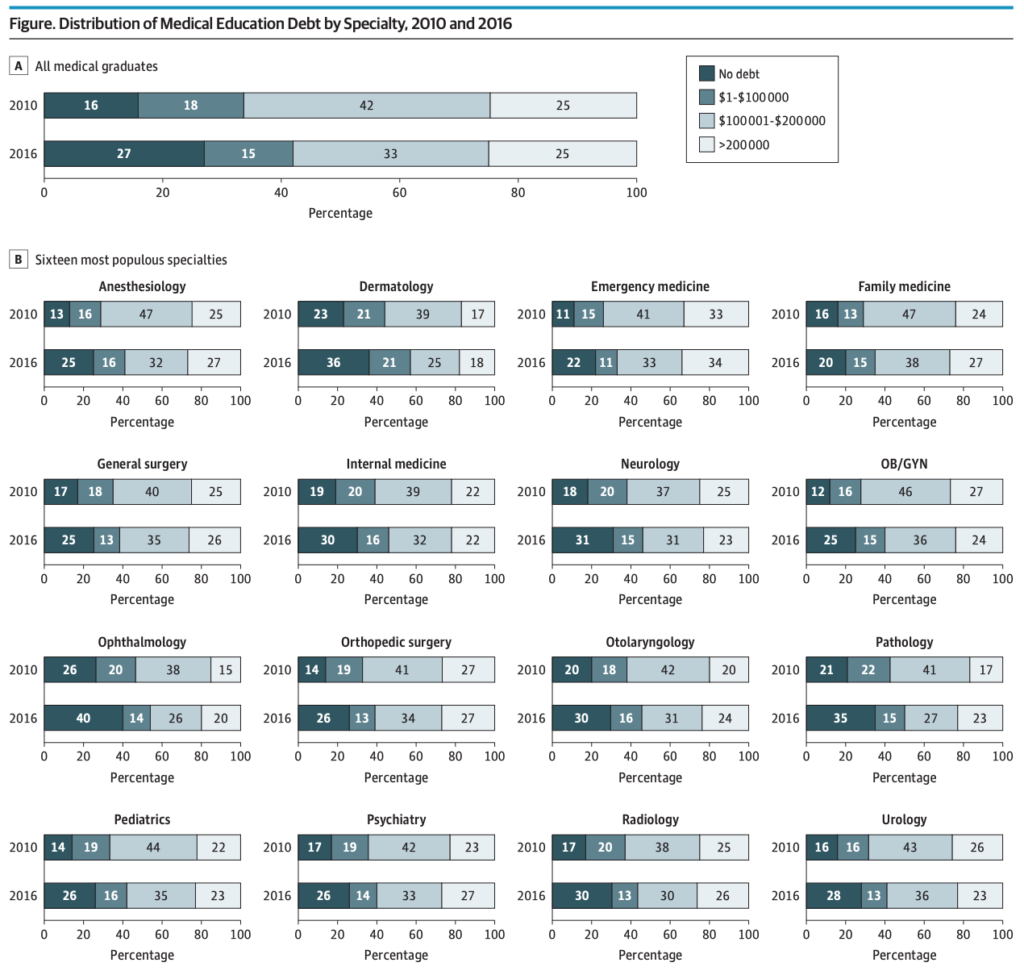
Even in medicine, we are seeing a disturbing trend. While the mean and median student debt are rapidly increasing due to high tuition rates, this is actually partially masked by the increasing percentage of medical students graduating with no debt. This suggests that a greater fraction of students come from means and have family support to cover medical school’s incredible cost. And those without that family support are either not getting in or are looking elsewhere.

It doesn’t stop at admission. These disparities and resource differences play out in specialty selection as well:

Over just a six-year period, the number of debt-free graduates almost doubled. And, overall, more competitive specialties like ophthalmology, ENT, urology, radiology have substantially more debt-free graduates than family medicine. Yet, we know we have a specialization problem in medicine. Free tuition at NYU isn’t going to change this massive headwind. The system needs retooling from far, far earlier.

On the WCI Podcast

01.31.20 // Finance, Miscellany

I had a lot of fun talking to Dr. Jim Dahle on this week’s episode of the White Coat Investor Podcast about student loans:


I honestly think we may have talked more about my journey on this episode than I have with my actual writing on this site for the past eleven years, but I hope listeners found the contribution of another writer/blogger to be interesting  (also, don’t turn up the volume or you may hear my sniffles; kids…).

As Jim mentions, he actually started The White Coat Investor a couple of years after I started writing here. But he’s since built an impressive empire, steadily produced a ton of content, basically singlehandedly changed the level of discourse for physician finance, and taught/inspired a generation of young doctors to think critically about money. It’s just an incredible achievement.

I’m really looking forward to speaking at WCICON20 this March and meeting some of you there!


Student Loans: In Print and Online

01.29.20 // Finance, Writing

I published the first edition of Medical Student Loans: A Comprehensive Guide in 2017. Waiting almost three years to put out a print version is what happens in the perfect storm of total DIY, extreme retentiveness, and being a generally lazy procrastinator. Oops!

But I’m happy to say I finally put the finishing touches on the print editions for both of my loan books this month, so those of you hankering for the perfect beach read need wait no further:

  • Medical Student Loans (for medical students & physicians)
  • Dealing with Student Loans (for everyone else)

Hurray!

Even better?

But in what is surely a terrible business move, I’ve also put the entire text up online at benwhite.com/studentloans/.

So yes, you too can join the ranks of folks still exchanging money for that hard-fought knowledge (thanks!).

And yes, you definitely still download a nice ebook file in the format of your choice in temporary exchange for your email address so I’ll have a nice big audience for that infrequent newsletter I’ll probably never actually start. (PS I even put the unsubscribe link in the first sentence of the download email; did you know it actually costs a bunch of money to have an email list? Crazy.)

But if you just want to scroll through 45k words in a web browser, now you can do that too.

Student loans are crippling a generation of Americans and have a chilling effect on personal+financial wellbeing. I’m just trying to do whatever I can to help you get the information you need to make thoughtful decisions about managing your debt.

If You Have a REPAYE Subsidy: Maximize It, Don’t Pay Extra

01.22.20 // Finance

A general rule of debt repayment is that it’s never a bad idea to put extra money towards paying down your debt faster. More money means getting out of debt faster and less money spent on interest. This is true for credit cards, most student loans, car loans, etc.

However, this is actually not necessarily the case in the context of income-driven repayment in the setting of negative amortization (i.e. when calculated monthly payments are unable to cover the amount of accruing interest).

If you can’t dent the principal, then there’s no point rushing to put extra money toward your federal loans. But why?

How Much Will It Take to Make Real Progress?

The average medical resident has big loans and relatively low income. While some intentional living can certainly free up some extra money for debt payoff, it’s much harder to have enough extra to completely mitigate negative amortization, let alone begin actually making progress on paying those loans down.

For example, $200k at 6% accrues $12,000 interest a year. A single resident earning $60k in PAYE/REPAYE has a monthly payment of around $344/month, or $3,864 for the year. In order to break even, you’d need to spend over $8,000 extra. Not chump change, especially on a resident salary.

Leverage Instead

Leverage the extra money you can earmark for loans to earn some interest elsewhere. A tax-advantaged retirement account (at least get the company match from work if available) or a Roth IRA are great options. When the question is between investing vs. paying down loans, the real answer is yes.

But if you specifically want to put money toward those loans, put it somewhere safe for now that earns some interest and then use it toward your loans. Don’t rush; it’s a waste.

To understand why you should wait, you need to have an understanding of how interest works with federal student loans and how payments get applied.

How Federal Student Loan Interest Works

1. Loans grow with simple interest, and capitalization is only triggered by very specific events. Capitalization is when accrued interest is added to the principal, thus resulting in a bigger loan accruing more interest at a faster rate. The main triggers are loan consolidation, the end of the grace period, changing repayment plans, and if/when you lose your partial financial hardship while in the IBR or PAYE plans.
2. You can’t pay down the principal by making extra payments until you’ve paid off all the accrued interest for a specific loan.

What this means is that once you begin repayment, you should never be surprised by a capitalization event. Your interest will continue to accrue every single day but it will not be added on to the principal unless one of the above factors takes place. Because the principal does not change, the amount of interest accruing remains constant. No matter how big the number gets, the rate of interest accrual remains the same until a capitalization event occurs. Paying down a little extra interest itself now as opposed to later does not change the natural history or your loans or alter the amount needed to pay them down.

In the REPAYE program, half of any accrued interest that is not covered by your monthly payment is forgiven. Therefore, the lower your monthly payment, the lower your effective rate. That doesn’t mean you shouldn’t still set aside more money every month toward debt repayment, just that there is a real financial benefit to paying as little as possible directly to the servicer in the short term until you are able to dent the principal.

That Money is Still Spoken For

To reiterate, I am not suggesting that you take this extra money that you could otherwise put your loans and spend it toward lifestyle inflation.

That money should be in some kind of loan payoff slush fund, such as a CD or interest-bearing online savings account like Ally Bank.

Earning 1 or 2% risk-free in a savings account will make that money go further when you finally use it on your loans. A lot different? No, of course not. But it does help just a little bit to mitigate what can be relatively high federal loan rates. Sure, it can function as an emergency fund too, but you should give that account a name like “loan money.” It’s not for vacations.

When to Deploy

If you’ve been saving money on the side for loan payoff, there are several situations in which it’s time to pull the trigger and make a large lump sum payment.

  • Right before a capitalization event, such as losing your partial financial hardship in IBR or PAYE.
  • Right before a private refinance.
  • When your income increases enough that you’re actually able to start making substantial progress on your loans, then you can jumpstart it with your slush fund.

Caveat: if you have not consolidated your loans and have some plus loans at a higher interest rate, one could conceivably put all extra funds into paying off that loan first. Given that an individual loan will be a smaller amount, it may be feasible to make progress on it. However, in general, I recommend most people consolidate for the reasons outlined in this post.

Maximizing the REPAYE Subsidy

One of the common REPAYE questions has been if I pay extra will it eat into my repaye subsidy and thus ultimately lose money? There has been some discussion, but the answer is supposed to be that you can. That said, I would almost never trust a servicer to ultimately apply these things correctly. As we’ve discussed above, there isn’t a great reason to do this on a routine basis. In most cases, you’d be better off leveraging that money elsewhere.

One thing to consider is that placing money into a traditional pre-tax retirement account like a pretax 401k/403b reduces your adjusted gross income (AGI), which reduces your payments by 10% of the contributed amount the following year, which in turn increases your amount of unpaid interest thus increasing your unpaid interest subsidy and ultimately lowering your effective rate. That’s a mouthful, but it means that the more you can lower your AGI, the less interest accrues on your loan.

That said, the income-lowering strategy is much more effective in reducing payments toward PSLF than in saving money on the accrued interest. For example, a $100 pre-tax contribution will lower payments the next year by $10 and would thus result in $5 of forgiven unpaid interest.

Lastly, if you are considering the possibility of PSLF

Never spend a dollar more than absolutely necessary directly on your loans until you are ready to permanently give up that plan. Any dollar extra you pay is a dollar wasted in the event of achieving loan forgiveness. Again, if you are nervous about the PSLF program, then you hedge your bets by being financially prudent in other ways, not by tilting at your loans.

Will I qualify for PSLF?

01.16.20 // Finance

After some high profile new stories about the initial 99% rejection rate for PSLF application, I wrote back in 2018 about how using that number as a means of summarizing the PSLF program was essentially clickbait.

I still see the 99% figure used all the time by ill-informed people in arguments about how everyone should abandon all hope and rush to the arms of an immediate private refinance without any consideration of critically important details such as the size of an individual’s crippling debt or how that relates to their current or expected income. Dunning-Kruger in action.

That said, the high rejection rate does illustrate the need for due diligence and careful planning, because what it really signifies is a lot of people’s general lack of attention to detail when it comes to critically important financial matters (e.g. the impact of investment fees on retirement planning):

Wrong loans. Wrong repayment plan. Wrong/unconfirmed number of payments. And (more rarely) wrong job.

A small fraction of that 99% also probably included some people who actually did know better but we’re hoping for a windfall. No harm in asking right?

Current borrower, the program is safe

If you’ve already borrowed loans, you’ll note that the master promissory note you signed includes this:

A Public Service Loan Forgiveness (PSLF) program is also available. Under this program, we will forgive the remaining balance due on your eligible Direct Loan Program loans after you have made 120 payments on those loans (after October 1, 2007) under certain repayment plans while you are employed full-time in certain public service jobs. The required 120 payments do not have to be consecutive. Qualifying repayment plans include the REPAYE Plan, the PAYE Plan, the IBR Plan, the ICR Plan, and the Standard Repayment Plan with a 10-year repayment period.

The MPN is a binding contract between you and the lender (the federal government). It cannot be legally changed. This is why all new proposals, from the Obama-era PSLF cap to the Trump’s hoped abolition, have always specifically excluded current borrowers. They have to. To change the rules of the game for an old borrower runs afoul of the common law doctrine of estoppel. In layman’s terms, you can’t go back on your word.

I know that sounds good in theory, but everyone who reads internet forums, social media, or the annual PSLF clickbait articles (even from major news outlets) is leery. Thankfully, there’s already some existing case law!

The Department of Education under Trump-appointee Betsy DeVos could at best be charitably described as the perfect example of how cabinet-level executive departments can be politically undermined while being used as political bait for horrible and/or clueless people. Under DeVos, the DOE did try to change the rules after the fact for a tiny number of people with non-501(c)(3) nonprofit jobs that did (and then “did not”) provide qualifying services. These jobs are approved on a case by case basis by FedLoan, and the DOE tried to retroactively undo FedLoan’s approvals.

So how did it turn out? The government basically lost. You can’t do that. I explained the details of the case here (I think they’re interesting).

The PSLF program is an entitlement. Entitlements are hard to change and hard to get rid of, and you can’t simply pull the rug out from under folks who made decisions based on you holding up your end of the bargain.

So, with that long preamble, I’d like to answer the question at the title of this post:

Will I qualify for PSLF?

I’ll answer with another question:

Well, are you doing the things that it says on literally every single document that you need to do?

Then yes!

After a 10+ year boondoggle of administrative suffering, you too can enjoy your free money.

You need:

  • Qualifying loans (Direct, not FFEL)
  • Qualifying repayment plan (REPAYE, PAYE, IBR, ICR, or 10-year Standard)
  • Qualifying full-time employment (Government or 501(c)(3) non-profit are the most straightforward)
  • 120 on-time monthly payments

That’s it.

You don’t need to wonder; you should know at every point during the process. Check out the Official PSLF Help Tool. If you have any doubts, keep submitting those employment certification forms to FedLoan. If there’s an unanticipated problem, you can find out within months. Unless you’re trying to get a non-501(c)(3) non-profit job approved (like in that lawsuit), there really shouldn’t be any question.

Yes, FedLoan can be terrible. And yes, sometimes you need to submit a CFPB complaint to get those manual payment recounts done when it seems that basic arithmetic is beyond their reach. No one said the process was pleasant.

But at this point, no one else needs to be surprised after a decade.

Older
Newer