Skip to the content

Ben White

  • About
  • Archives
  • Asides
  • Support
    • Paying Surveys for Doctors
  • Medical Advice
    • Book: The Texas Medical Jurisprudence Exam: A Concise Review
    • Book: Student Loans (Free!)
    • Book: Fourth Year & The Match (Free!)
  • The Girl and the Unicorn
  • Radiology Jobs
  • #
  • #
  • #
  • #
  • About
  • Archives
  • Asides
  • Support
    • Paying Surveys for Doctors
  • Medical Advice
    • Book: The Texas Medical Jurisprudence Exam: A Concise Review
    • Book: Student Loans (Free!)
    • Book: Fourth Year & The Match (Free!)
  • The Girl and the Unicorn
  • Radiology Jobs
  • Search
  • #
  • #
  • #
  • #

The ABR Online Testing Experience

11.17.21 // Radiology

When I finally got around to taking the Neuroradiology CAQ Exam this fall, I finally had the pleasure of partaking in the ABR’s remote testing platform. I put a lot of work into my posts about the Core and Certifying Exams back in the day, but they do hail from the pre-pandemic era.

Here are some thoughts on taking an ABR exam from the comfort of not Chicago or Tucson:

Big Brother

ABR relies on a third-party company called Proctorio for monitoring. Update: As of 2022, the ABR is now handling remote monitoring in-house instead of relying on a third-party vendor.

Everything—including the real-time video monitoring, capturing a photo of your picture ID during the start-up process, and the “room scan”—rely on the webcam. This feature was clearly intended to be used on a laptop, which you could easily pick up and spin around the room. The ABR now requires a separate dedicated side-view webcam, which makes the acrobatics a bit more complicated.

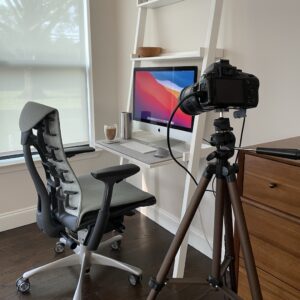
Instead of buying a separate webcam, I used a super old DSLR with a $15 HDMI to USB video capture card (the knockoff of the better Cam Link). This works fine (and it’s what I use for Zoom calls to have that beautiful bokeh so that people like me more), but it’s worth noting that if you don’t have good autofocus (and mine is so old that it does not), that it may take a few tries to get the screengrab of your photo ID good enough to satisfy Proctorio’s artificially intelligent needs. Depending on your desk set up, a relatively short cable connecting the camera to the computer or a tripod to have the camera high enough to actually see anything if you don’t have a dresser or something suitable nearby can make the room scan awkward and a bit tenuous. A longer USB cord helps. After around 5 minutes of finagling, eventually, I was allowed to take the test.

You could also use your phone as a webcam by using one of many inexpensive apps like Camo or EpocCam, which is probably the best option, especially if you already have some sort of suitable stand or one of the infinite variety of cheapo phone tripods.

Anyway, what I’m trying to say is I don’t think most people need to buy a dedicated external webcam just for the purpose of taking one of these ABR tests. Especially since most webcams are terrible.

I will say that Proctorio didn’t make me install any apps on my phone, and the Chrome Extension is easy to uninstall. I don’t think anyone is going to have their identity stolen or be harassed by call center employees. While I am admittedly not very experienced with the myriad options for education spyware, it seems like the ABR picked one of the better players.

Computer Set-up

I really wanted to use my home workstation. It has direct fiber internet and a system I use every day for radiology-type stuff. However, Proctorio and the ABR have a 1 monitor rule, and I—in my radiologist glory—have 4 monitors. To satisfy Proctorio, any extra monitors in the space have to be missing from your system entirely, so simply turning them off isn’t good enough. They need to be totally unplugged from your computer so that they don’t show up. I use a dual PC system set-up to read simultaneously for the hospital and our outpatient PACS by swapping monitors and peripherals between two different PCs using a KVM switch. It’s awesome. But the nest of monitor cords is no joke, and the settings are just how I like them, and there was no way I was going spend the time unplugging stuff and jeopardize any of that in order to take a 3-hour exam with a bunch of low-quality JPGs.

Instead, I took it on my 2017 iMac over WiFi, which is across the house from the router, and it was fine. The biggest problem was getting Proctorio happy with the backlighting from the adjacent window overexposing the camera and making me look too dim.

Yes, I did roll over my attending chair, the Herman Miller Embody, from across the house for the experience, and it was worth it.
The Practice Test

The practice test is a 98 question process, but really it’s just designed to get you to make sure you can pass Proctorio’s welcome barriers and familiarize yourself with the software. The content is a random hodgepodge of questions, but there is no performance feedback or answer key, limiting usefulness as an actual practice exam experience.

The content parallels the Core Exam, which is to say I found it more difficult now as a super high-performing experienced attending radiologist than I would have as a resident. Go figure.

The Online Platform

I would show you some screenshots, but, you know, I can’t.

The software is totally fine. It works. You have a bunch of tools to manipulate the images, but since most images are just static screen grabs of middling quality, you usually don’t need to do anything. In fact, the image sizes are small enough and the questions themselves short enough that you really don’t need or even want a large monitor or anything fancy to take the exam. Your average laptop screen has plenty of real estate.

The ABR locks your past performance every 30 questions to prevent you from altering your responses to prior questions after you’ve left the surveillance zone for breaks (aka cheating). Locking so frequently is a touch annoying, and I’m sure the policy frustrates the people who want to blaze through the whole test and then agonize for hours on all the questions they flagged at the end. Psychologically, this is probably healthier, though it does make flagging a question basically useless.

I wish they just locked questions at breaks and not after so short a period, but given intermittent connectivity issues, the shorter batch size probably helps substantially reduce their tech support demands. It’s a worthwhile price to pay for the convenience.

Another irritating feature is that the ABR really wants you to move forward through the exam and not backward to revisit old questions, so much so that if you try to visit the previous question, the software prompts you with a pop-up saying (paraphrasing) “forward is so much better, are you sure you want to go back?”…which is annoying. I think the idea here is that they especially don’t want you to see a question, not answer, go backward, lose access in some way, and then have to unlock the question for you and/or question your integrity. 

On exam day, I got a brief “connection lost” warning twice, lasting for a few seconds before being reestablished automatically, otherwise no interruptions. I know people personally and online who had less good luck, sometimes being completely kicked out and needing to call to have questions unlocked. To their credit, I’ve only heard good things about ABR customer service when it comes to helping with exam connectivity issues.

Overall

Overall these inconveniences are a small price for being able to wear pajamas and take a break literally whenever you want, which is wonderful. The ability to use a bathroom mere feet away or get drinks and snacks on a whim creates a completely different ambiance than a typical testing experience.

Not having to pay for flights and hotels, waste days on both ends for travel, and leave your family is also almost priceless.

In some ways, it’s a little harder to get in the normal high-stakes exam headspace without the suffering, but it’s a breath of fresh air that I enjoyed nonetheless. I bought a twelve-pack of Diet Mountain Dew just for the occasion, and I made myself a nice fresh ice coffee as well (see above, hat tip double-walled insulated glasses) to sip while answering ludicrous questions about differentiating spinal cord tumors. 

If that’s not the dream, I don’t know what is.


Review: Sulcus Neuroradiology CAQ Prep

11.12.21 // Radiology, Reviews

The neuroradiology subspecialty exam (aka the CAQ or certificate of added qualification) is a tedious, basically redundant, and expensive waste of time taken by a relatively small number of people every year.

As a result, there are very few dedicated recourses.

In fact, there is only one, and it’s Sulcus.

Based on an informal survey I did of CAQ takers, the Sulcus bank is relatively popular despite what are generally poor reviews online. In my informal poll, almost half of respondents admitted to using it. I chalk this up to the CAQ exam being exceedingly expensive, people not wanting to fail it, and this being the only dedicated product.

Related note: Sulcus also now offers MSK and Mammography programs, neither of which I looked at.

Reviewer Disclosure

Sulcus did not pay for this review nor have they seen it prior to publication.

They did provide me with 7 days of free access. I have a life, so that wasn’t sufficient for me to view the entire product, but it was enough for me to form an opinion. I’m not sure I would have finished it regardless, and I did not purchase the product afterward for further studying.

I also have no discount code for you, dear reader.

Platform

It’s a little clunky, but it works.  

You must “create a quiz” as a separate step before you can actually take said quiz.

There is no tutor mode. 

The site is technically mobile-friendly but the left sidebar (which is just the question numbers) takes priority, meaning that you need to scroll down past the question navigation to do every single question and read every explanation. Very tedious.

Content

There are a total of 562 questions grouped into 175 cases.

As in, there are several questions per case/diagnosis/image(s). For example, doing my first 5 cases used up 16 questions.

The cases themselves are solid. But when each case has three or sometimes four questions, the first is usually high yield, the second is borderline, and the third is basically just for giggles.

The question format is nothing like CAQ. Most CAQ questions are diagnosis-based.

Many Sulcus questions are multiple-choice “pick the correct statement” nonsense, where you evaluate a bunch of statements and then pick the one that is true. It also contains questions that are negatively framed (“which of these are NOT…”) questions that are garbage psychometrically (in their defense, these still crop on ABR’s exams rarely as well).

You’ll also get a lot of extended multiple T/F questions, where you need to evaluate a whole bunch of statements about the diagnosis and get each of them right in order to be “correct” overall. So, the end result—as other reviewers have alluded to—is mostly irritating/demoralizing.

Extended matching questions are pretty rare but fine.

Overall, the bank trends too much toward hyper-detailed in-the-weeds stuff, making it very inefficient to review in quantity for a busy practicing radiologist. The CAQ is an image-based test mostly of diagnosis, so testing a whole bunch of second-order factoids is not worth your time.

In Sulcus’ defense, I have a suspicion that the CAQ exam has changed significantly over the years. It very well may be that its current format more closely resembled the CAQ of old before changes brought the question style more in line with the modern multiple choice offerings of the Core and Certifying Exams. I support this theory with two points.

  1. No one would choose to write questions like this for no reason.
  2. The current (but clearly out of date) CAQ exam study guide from 2017 suggests that most questions would be part of linked question sets: “After the candidate makes her/his choice, one to three follow-up questions will typically be asked.” This is simply not the case. Most questions are solitary single best answer and do not go on to hammer you on miscellaneous second-order details.

Survey Results

I did a brief survey online and got 38 responses. Of the 18 people who said they used Sulcus, there were only two written comments: “didn’t think was relevant” and “was the highest yield by far.”

I think the reality is somewhere in between.

Pricing

$399.

Free Sample

There is one sample case in a slideshow at the bottom of the main page.

Verdict

Eh, pass.

A decent collection of wide-ranging cases; not a bad learning tool but extremely expensive related to other options and not an efficient CAQ review for the practicing neuroradiologist.

Unless you really have a CME fund to burn and nothing else to spend it on, you don’t need something this tedious and demoralizing to get through for the purposes of passing the CAQ exam. Some regular cases books, like Neuroradiology: A Core Review, will get the job done.

If you really just want a chance to see some pretty solid cases, take some great and some excruciating multiple-choice questions, and really hammer some low-yield esoterica to impress trainees and specialists, then this is an excellent choice.


The ABR is Sorta Changing Its Fees

10.06.21 // Radiology

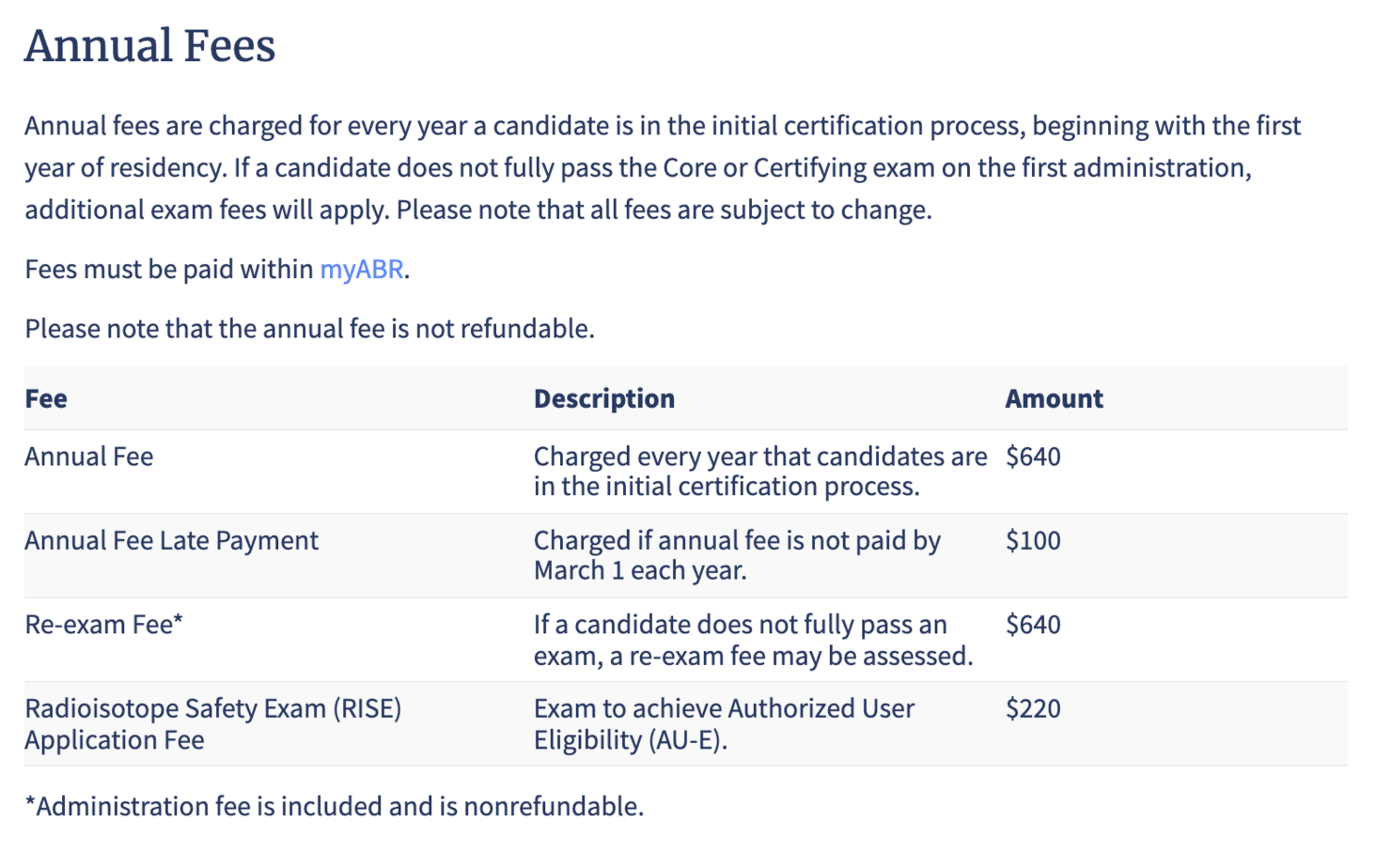
In recent years, the American Board of Radiology (ABR) has utilized a membership fee model, where—for example—those working towards an initial certification in diagnostic radiology would pay a $640 annual fee until passing the Certifying Exam. Since one takes the Certifying Exam 15 months after finishing residency, that has meant recent diplomates have paid a specialty tax of around 1% of their gross income for a total of five years before enjoying the privilege of paying a mere $340 per year for MOC forever.

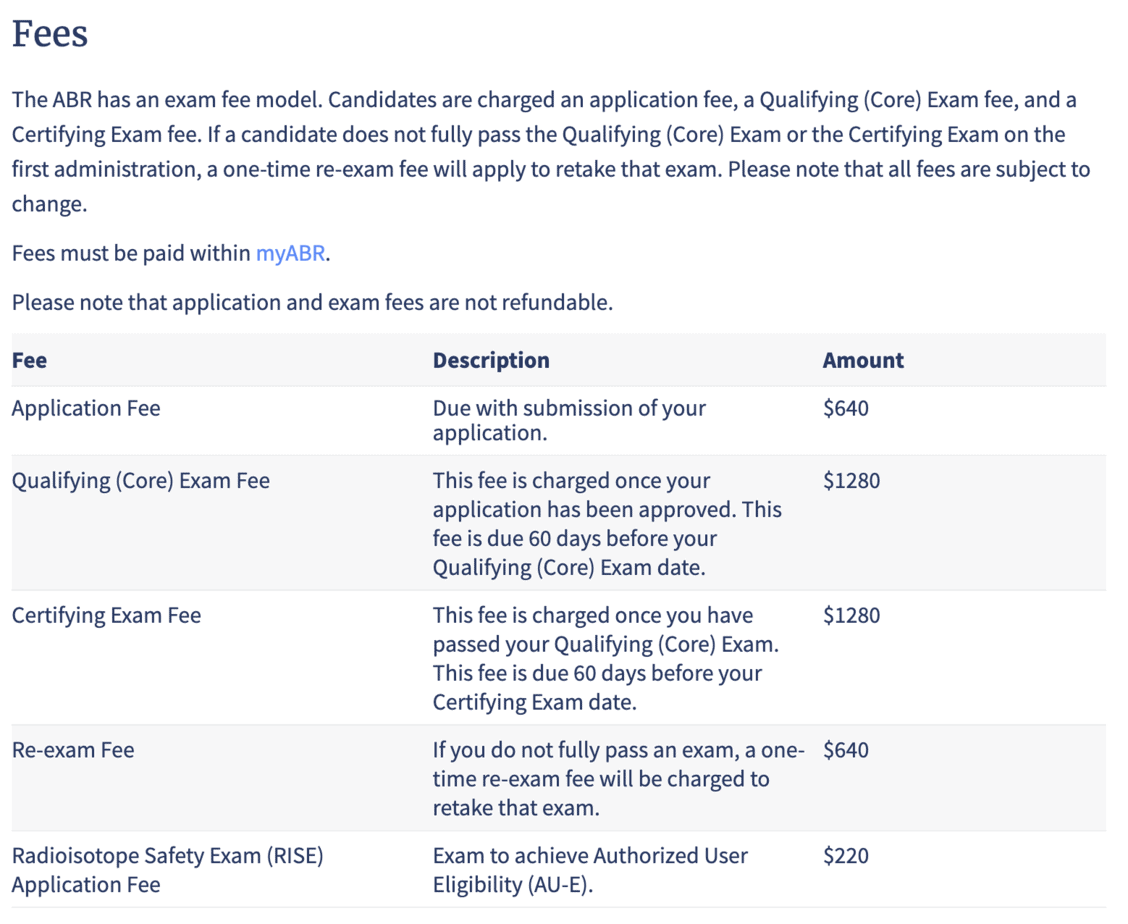
The fee schedule looked like this:

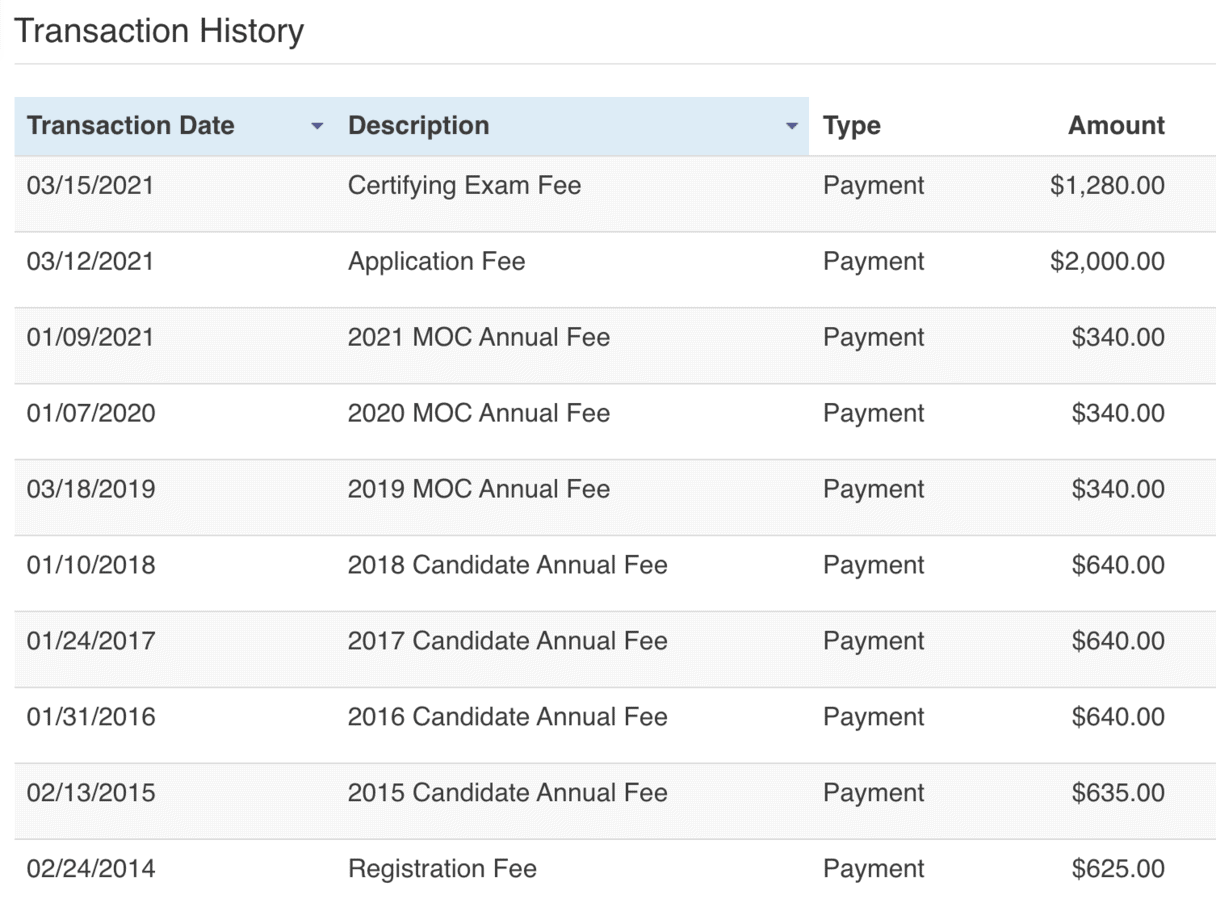
To illustrate, here’s my payment history (the annual fee actually increased a bit during my training because money).

As of September 2021, ABR has moved to “an exam fee model.” How does that look? Well, a one-time $640 application fee followed by a $1280 Core Exam fee and a $1280 Certifying Exam fee.

It doesn’t require a doctorate to note that the total cost for initial certification is the same: $3200.

That fee continues to put radiology in the highest echelon of medical specialties in terms of board costs, as enumerated in this 2017 paper (which incidentally undercounted the radiology costs).

What has changed is that this fee structure is now standard across other exams and is resulting in a decrease in the (otherwise ludicrous) subspecialty exam fees.

You see, until now, the much shorter half-day CAQ exams actually cost the most! As above, you can see I paid $3,280 this spring for the privilege of spending a morning taking a poorly formulated exam to pseudo-prove that I can totally do the thing I already do every day. That’s more than the cost of the combined total of the much, much bigger Core and Certifying Exams.

But, as of this September 17, 2021 update, it’s merely the same $640 application fee + $1280 exam fee for a total of $1,920 (a savings of $1,360!).

Of course, before you get any warm fuzzies about their generosity, keep in mind that the CAQ exams comprise a relatively small proportion of ABR revenues since only ~200 people take them every year, and, meanwhile, MOC revenues continue to grow year after year. The ABR, per its internal narrative and official documents, has recently been operating at a loss.

Thankfully, they have some retained earnings on hand to mitigate the red.

Equity, Organized Medicine, and the Radiology Value Chain

07.26.21 // Medicine, Radiology

It’s often said that large organizations are difficult to steer and slow to change course, but that’s only part of why they sometimes act in seemingly inexplicable ways. There’s another more insidious reason, and that is conflicts of interest, not just within leadership but also in the changing demographics of the membership.

A passage from “Value Chain: Where Radiologists Should Put Their Focus in Threats Against Income” by Seth Hardy MD MBA in Applied Radiology:

So, while private/public equity firms can use leverage to amplify profits to the upside, leverage has an opposite effect when gross income is in decline. Any cuts to reimbursement would be truly devastating to these firms’ employees; since the debt holders get paid before the radiologists, the impact on employed radiologists’ salaries may be significant. As equity-employed radiologists make up a greater share of dues-paying members within organized medical societies, it is easy to understand why the proposed CMS cuts were characterized as draconian by those societies. But a clear understanding of value chain by physicians is increasingly critical to evaluate the rhetoric of our medical society leadership.

I am now a partner in a physician-owned independent radiology practice. A CMS paycut would mean that we earn commensurately less money—not that we will become insolvent.

That should count for something when choosing where to work.

To STAT or not to STAT

07.01.21 // Medicine, Radiology

A passage about limited resources and optimizing imaging from The Emergency Mind: Wiring Your Brain for Performance Under Pressure by Dan Dworkis MD PhD:

Within the broader context of your responsibility however, there frequently will be significant variability in the relative urgencies of individuals being imaged. Some patients—like a person seemingly experiencing an acute stroke—do need to be scanned immediately. Others—such as a patient with abdominal pain, stable vitals, and a reassuring physical exam—while no less “deserving” of those resources, would receive nearly equal benefit from being scanned now as in an hour from now. Optimizing care across the field in this context would involve prioritizing CT scans for those patients who would receive outsized benefits from immediate imaging, even if this makes some other patients wait longer.

Put a different way: If everything is stat, nothing is stat.

Stat abuse is one of those crimes especially tempting to inpatient teams in busy hospitals. It’s natural to want answers (and dispo) as soon as possible, and we assume that we will get them faster if we increase the priority of the exam.

All a clinician knows is that sometimes something ordered routine takes forever and that ordering stat should generally result in it being performed faster. They may not even care if the read is prioritized in all cases so long as the patient is freed from the waiting and future transport.

It’s also human nature for there to be a distribution with certain individuals ordering an outsize proportion of “stat” exams. The negatives of over-ordering or inappropriate priority are almost always placed on other staff. In a zero-sum game, selfish behavior may be an optimal choice for individual success even if it makes the system less efficient overall. Hospitals very rarely scold their staff for such abuses.

I don’t think most clinicians even have any idea where along the spectrum their behavior falls. Knowledge of outlier performance one hopes might curb excesses, and that data would certainly be helpful for individuals to know (presuming those individuals are capable of feeling shame and said shame functions as a deterrent). Such information would have to be long-term and stratified well to be meaningful (we should expect different levels of stat exams as a fraction of orders from different hospital units, for example). Otherwise, data are dismissible.

Ultimately, pleading and punishment are often ineffective and/or undesirable.

A more helpful approach would include data to guide decision-making on a case by case basis:

The EMR should show in real-time the expected wait for different study types based on the current queue and exam types pending, both inpatient and outpatient (i.e. how many unnecessary exams are obtained during an inpatient stay due to fears of long delays for outpatient follow-up?). Yes, a routine study may unexpectedly get bumped further down the line, but a smart system would incorporate predictions based on the current patient census, admission diagnoses, time of year, and whatever else some machine learning algorithm would include its impenetrable black box of Skynet code.

It would be extremely helpful for all parties to know if an MRI should be expected today or tomorrow, sometime this afternoon or more likely at 3 am.

And so, yes, of course, people are working on this in the machine learning world. But hurry up. I for one will continue to welcome our AI overlords and their promised efficiency gains, but I’m still waiting.

Diganostic FOMO

05.24.21 // Medicine, Radiology

From Suneel (brother of Sanjay) Gupta’s Backable: The Surprising Truth Behind What Makes People Take a Chance on You:

Apply the following quotation to why doctors don’t want to make the call:

If the fear of betting on the wrong idea is twice as powerful as the pleasure of betting on the right idea, then we can’t neutralize the fear of losing with the pleasure of winning. We can only neutralize the fear of losing with…the fear of losing. Enter FOMO, the fear of missing out. For backers, the only thing equally powerful to missing is…missing out.

Gupta goes on to discuss how potential backers initially too scared to be the first investor eventually pile on to avoid missing out on rare unicorns.

The fear of betting on the wrong idea in medicine manifests through overtesting and hedging. More than our desire to be right, we really don’t want to be wrong. But we can’t use the usual FOMO to our advantage, because medicine isn’t about making pitches or raising money but about directly helping individual people.

We don’t want to miss anything and so are forced to entertain everything, even if that means everyone in the ED gets a CT scan or a radiologist gives an impression a mile long with the words “cannot be excluded” featured prominently next to something extremely scary.

The true solution is this: we need to disentangle the outcome from the process. You can have good outcomes from bad decisions (dumb luck) or you can have bad outcomes after good decisions (bad luck). Luck and uncertainty are part of life, and they’re a big part of medicine. We should expect some bad outcomes even when doing the right thing, and we shouldn’t forget that overtesting and overdiagnosis have their own costs, risks, and harms. Passing the buck to the future doesn’t mean it won’t be paid.

By not making the call, we are making a decision: a decision to abdicate the diagnostic yield of an encounter or examination.

There are absolutely times when uncertainly is prudent. There are true “differential” cases. But the FOMO of diagnostic medicine should be passing up an opportunity to clearly define the next steps in a patient’s care.

Student loan debt predicts burnout

05.14.21 // Miscellany, Radiology

From “Predictors Between the Subcomponents of Burnout Among Radiology Trainees” by Le et al. in JACR.


In summary:

Debt level < $200,000 was associated with lower [emotional exhaustion] scores among upper-level trainees and was the only predictor of burnout that significantly affected multiple years of training.

I suspect there is a dose-response above that debt level as well.

Uncertainty breeds despair. Make sure you develop a student loan action plan.

A Chance for Meaningful Parental Leave During Residency

03.24.21 // Medicine, Radiology

Last year, the ABMS—the umbrella consortium of medical specialties—waded into the established toxic mess of medical training schedules with a new mandate to provide trainees with a nonpunitive way to be parents, caretakers, or just sick:

Starting in July 2021, all ABMS Member Boards with training programs of two or more years duration will allow for a minimum of six weeks away once during training for purposes of parental, caregiver, and medical leave, without exhausting time allowed for vacation or sick leave and without requiring an extension in training. Member Boards must communicate when a leave of absence will require an official extension to help mitigate the negative impact on a physician’s career trajectory that a training extension may have, such as delaying a fellowship or moving into a full, salaried position.

6 weeks over the course of an entire residency may not seem like much given the vagaries of life, but it’s a better floor than many programs currently offer. A graduation delay sucks, and it’s the kind of punishment for living your life that causes many doctors to put off big milestones like starting a family. Medical training already takes a long time, and ~1 in 4 female physicians struggle with infertility (and in that study, 17% of those struggling would have picked a different specialty).

This issue is being addressed across medicine, but we’re going to discuss it in the context of radiology because I am a radiologist.

The American Board of Radiology’s recent attempt at how such language should look has drawn some ire on Twitter. Here is their email to program directors that’s been making the rounds:

Image

They proposed that a program “may” grant up to 6 weeks of leave over the course of residency for parental/caregiver/medical leave as a maximum without needing to extend residency at the tail end. The language here doesn’t even meet the ABMS mandate, which again states that a program “will” provide a “minimum” of 6 weeks (and explicitly states that said 6 weeks of leave shouldn’t be counted against regular sick time).

The ABR could have simply taken the straightforward approach of parroting the ABMS mandate. They could have—even better—taken the higher ground with an effort to trailblaze the first generous specialty-wide parental leave policy in modern medicine.

Instead, they have advocated for a maximum of six weeks, because any more and they feel they wouldn’t be able to “support the current length of required training.” As in, if a mom gets 3 months off to care for a newborn then the whole system falls apart.

I think they realized it would be prudent to ask for feedback first and then make the plan because a new softer blog post removes any specific language:

We need your input to develop a policy that appropriately balances the need for personal time including vacation as well as parental, caregiver, and/or medical leave with the need for adequate training. 

It is important to realize that the ABR is not restricting the amount of time an institution might choose to allow for parental, caregiver, and/or medical leave, nor are we limiting the amount of vacation a residency program might choose to provide. These are local decisions and the ABR does not presume to make these determinations. However, above a certain limit (not yet determined), an extension of training might be needed to satisfy the requirement for completion of the residency. 

Of course, in the original proposal, the ABR literally did want to limit program vacation (to 4 weeks, see above).

After the mishandling of the “ABR agreement” debacle and the initial we-can’t-do-remote-testing Covid pseudo-plan and now this, I hope the ABR will eventually come to the conclusion that stakeholders matter and that we can make radiology better by working together as a community.

Radiology is a “male-dominated” field, but it shouldn’t be. A public relations win here could make all the difference.

Plenty of Slack

I think there are more than six weeks of slack in our 4-year training paradigm, and it’s hard to argue otherwise.

When the ABR created the Core Exam and placed it at the of the PGY4/R3 year, they created a system where a successful radiology resident has proven (caveat: to the ABR) that they are competent to practice radiology before their senior year. It created a system where the fourth year of residency was opened up largely to a choose-you-own-adventure style of highly variable impact.

We have ESIR residents who spend most of their fourth-year doing IR, and we have accelerated nuclear medicine pathway residents that do a nuclear medicine fellowship integrated into their residency. There are folks early specializing into two-year neuroradiology fellowships during senior year, and others who take a bevy of random electives that they may never use again in clinical practice.1(I did 3-month nuclear medicine and MSK mini fellowships during mine. And an extra month of cardiac imaging. Guess how mission-critical all of that ended up being for my career as a neuroradiologist.)

We have many programs with a whole host of extracurricular “tracks” where residents might spend protected time every week doing research, quality improvement, or clinician-educator activities. I would know, I did all three during my residency. We have residents doing research electives and all kinds of other interesting things that may worthwhile but have no positive impact on their ability to practice radiology clinically, which is the primary purpose of residency training.

A hypothetical example: Take a research track resident with one half-day protected time every week for 40 weeks a year (say because of 8 weeks of night float and 4 weeks of vacation). That’s 20 days a year of reduced clinical activity. 20 working days is basically a month. If they have their R1 year to just focus on learning radiology before taking call, then over the next three years that resident would be “missing” 3 months of clinical time. But no one is seriously arguing that these tracks should postpone residency graduation.

We already have a system where there are minimum case requirements for residents to complete residency training. Last I checked, the ABR is certifying radiologists in the domain of clinical radiology, not their number of peer-reviewed publications or ability to do a sick root cause analysis.

Radiology residency may be four years after a clinical internship, but it’s clear that there is no standard radiology training program clinical “length” despite that fixed duration. Some residents are already doing far fewer months.

No one is adding up diagnostic work hours and saying you need 48 weeks/yr * 52 hours/wk * 4 years = 9,984 hours.

It’s not a thing, and it shouldn’t be.

Competency-based Assessment and Reasonable Limits

The core problem is that we have time-based residencies masquerading as a proxy for competency. You don’t magically become competent when you graduate. Competency is a continuum. Hiring trainees for a set number of years is convenient. It’s easy to schedule. It’s easy to budget. But it’s an artifact of convenience, not a mission-critical component of clinical growth.

There are R3 residents who are ready for the big leagues, and there are practicing doctors who should honestly move back down to the minors. No one is going to argue that a little more training makes you worse. But the logic that more is better gets us to the unsustainable current state of affairs, where doctors are accumulating more and more training to become hyper-specialized in the least efficient way possible while non-physician providers bypass our residency/fellowship paradigm to do similar jobs with zero training.

We all get better with deliberate practice. The question isn’t: is more better? The question is how much less is still enough for independent practice?

Obviously, the ABMS member boards like the ABR don’t exactly have the power to force institutions to change policies directly, and they probably don’t want to. But they do set the stage by mandating the criteria for board eligibility.

I would argue that the ABR should set a minimum threshold and no maximum. If a program is happy with that resident’s progress and they pass the Core Exam, then consider the boxes checked. Let everyone be treated with dignity and then give the programs the flexibility to compete in the marketplace of support.

When my son was born, I was able to take 4 days of sick time and then went straight into night float. That’s bullshit. You want to see motivation? Tell an expecting resident that if they’re a total champion that they can spend as much time as they need with their baby without delaying graduation.

Less than 6 weeks is unacceptable. And while a 6-week minimum is an improvement, I think the true minimum consistent with current training practices that should also have a chance of being implemented is three months.

I’d love to see six months or more. I don’t think that’s going to happen as a minimum, and there’s a very reasonable argument against it as underperforming residents really may need some of that time back. It would be nice to see language that demands 3 months, has no maximum, and strongly encourages programs to work with residents on a case-by-case basis to ensure they are ready for graduation with however much time they have.

But the first step is to have a minimum that doesn’t punish women who want to stay home with their infants until they’re done cluster feeding. Convince me otherwise.

Fairness

The ABR doesn’t use the language of “fairness” in their email, but I suspect the perception of fairness is at play. It’s almost always at play when older doctors consider policies that might benefit younger physicians. It’s the I-did-it-this-way-and-I’m-amazing-so-it-must-be-an-integral-part-of-the process. It’s the hazing.

Right now, some lucky residents across the country get varying degrees of time “off” thanks to PD support in the form of research electives, reading electives, and program staff simply looking the other way. We need to standardize a fair minimum that enables programs to provide a consistent humane process and not just put trainees solely at the mercy of their PDs and local GME office.

Yes, it’s true that if you allow parents time to be parents or people to take care of loved ones or people time to recover from illness that some residents will work fewer months than others. Every resident has their unique experience, but a policy change will also mean that every resident may not have a similar “paper” experience. That’s a fact.

Some people will say, that’s not fair. That it’s not fair to single residents or non-parents. That it’s not fair to the able-bodied. Or to those whose aging parents are healthy or have the resources to support themselves.

But let me provide a counterpoint:

I don’t think fairness means that every single resident has to have the exact same experience. They already don’t. I think fairness means we treat humans with the respect and compassion that every person deserves. I want to live in a world where everyone gets time to be a parent, even if yes, that world means that some doctors may have a career that is a few months shorter.

I think fairness means not punishing people when life happens just because making people jump through hoops makes it easier to check a box.

If you’re ready to practice, you’re ready.

If we need to reassess the validity of an exclusively time-based (instead of competency-based) training paradigm in order to do that, then let’s get to it.

The ABR is accepting feedback until April 15.

Physics is now just another Core Exam section

03.12.21 // Radiology

Probably the biggest news in radiology over the past year (at least for residents) was the announcement that the upcoming and all future ABR examinations were moving to an online remote/virtual format. That’s worked out pretty well so far.

One bit of nice unexpected news that was announced very quietly this week was that the ABR Core Exam, the first and only meaningful component of the radiology exam certification cycle, would no longer have a separately-graded physics section that could—by itself—prevent overall exam passage. Physics will still comprise an unchanged amount of the test but will be graded as just another section along with all the rest: a component for overall passage but not a section that examinees can “condition” and be forced to retake at a later time.

Holding physics somewhat apart was a holdover from the pre-Core Exam era when there was a completely separated dedicated physics exam.

The ABR made this decision during the grading process just last week. I’m sure that recent examinees would have really appreciated this information during their studies, but timing aside I fully support the ABR’s choice here. Strong move. What’s next?

Leadership and Resident Satisfaction

03.02.21 // Radiology

It’s residency Rank Order List season, and I thought I’d share a paper published in AJR from 2016 titled, “Radiology Resident’ Satisfaction With Their Training and Education in the United States: Effect of Program Directors, Teaching Faculty, and Other Factors on Program Success.”

It was a small study where the authors surveyed 217 radiology residents.

Of that group, 168/216 (77.8%) of residents were satisfied overall with their residency programs.

You’re always going to have some sour grapes, and it’s not possible from the data to figure out how much of that fraction might be related to noncontrollable factors like the city, the stresses of dealing with student loans, or other factors. But as the authors noted, that’s a big difference from the golden era:

This is lower than reported in similar previous national surveys conducted by the American College of Radiology, which reported a 97.8% level of job satisfaction of radiology trainees in 2003, and 97.6% level of job satisfaction in 1995.

Like with internet comments and product reviews, convenience surveys always lean toward the dissatisfied. But the data are still interesting because they can highlight the causes for dissatisfaction, even if they play an outsize role compared to the general community.

The three sub-categories with the greatest correlation with overall satisfaction were satisfaction with the program director and administrative office, daily workstation experience, and faculty.

So basically everything.

But of the three, the program director and administration were by far the most dominant. I suspect it’s more of a break not make scenario:

The factor with the greatest correlation to satisfaction with the program director and administrative office is how approachable and responsive the administration is to resident concerns.

A good program director may help make a program, but a bad one can definitely tank one.

A good PD is both a boss and an advocate. While not all trainee complaints are necessarily fixable (or even reasonable), accountability, transparency, and attentiveness aren’t something to take for granted in program leadership. Culture colors everything.

It might be impossible to change the culture of the hospital. It might be impossible to reduce RVU pressures on faculty or improve mediocre teachers. So the survey is actually good news because the program leadership is far more mutable.

There was one throwaway statistic they reference from a 2003 study that ties into the daily workstation experience/faculty components:

A survey with 132 junior radiologists revealed that 68% of the responders left academia after an average of 3.28 years because of low pay and lack of academic time.

That was almost 20 years ago, and the RVU pressure and lack of academic time have gotten worse since then. I wonder what that number is now.

My group is extremely stable, but I’ve seen a ton of turnover amounts young attendings in both academia and private practice. I don’t think enough practices of any variety are willing to allow for a Goldilocks approach between productivity and revenue.

Older
Newer