Prime Day is here, and while Wal-Mart is copying the idea, I think only Amazon can make a national news story by unilaterally promoting a sale. And while good discounts on some Kindles, other miscellany, and fabled “lightning” deals every 10 minutes may generate some revenue, I have no doubt that the main thrust of the promotion is to drive new Prime memberships. After all, you can still join Prime and experience the fun with a free 30-day trial (or Amazon Student for 6 months free with a .edu address), and Amazon believes that once you go Prime, you never go back.
Last updated April 2020.
Medical school is expensive and getting more so every year. Meanwhile, federal student loans are still at above market rates (and many private ones are predatory). Combine the two and a new doctor will borrow more and then pay more for the privilege than at any other time in history.
Over the past two years, historically low interest rates and a rebounding economy mean that private banks have re-entered the student loan business, particularly on the refinancing side.
As a resident, your options are essentially limited. Starting in March of 2015, DRB became the first company to offer a resident refinancing program that is unique, practical, and affordable for residents ($100 a month).
I wrote about refinancing as a resident at length in this post.
Otherwise, here is the complete picture for student loan refinancing.1
TL;DR
There are only a handful of options and the initial applications are short (really short, ~5 minutes or less). Rate ranges are typically concordant and are theoretically as low as the 2%-range variable across lenders. All quote you low rates assuming you’ll auto-debit from a checking/savings account. Initial applications will result in a soft pull on credit (does not affect your credit score) and give you a preliminary rate, so if you have good cash flow and can otherwise afford your loans (i.e. you’re an attending), you’ll do yourself no harm by simply applying for refinancing from each company and seeing which one is willing to refinance you at the best rate:
[This old page is here for archive purposes. I’ve removed the specific company references.]
Summary
Overall, the interest rate ranges offered by these companies are generally comparable. Typically when one lowers their rates, the others have followed quickly followed suit.2 The increasing competition in this space has been excellent for consumers, because the rates offered even a year ago weren’t that much lower than the federal ones. So, if you have several potential options based on your loan burden and your income, you might as well apply to all and see who gives you the best deal.3 Preliminary applications generally take 2-5 minutes, so there isn’t a big time investment in doing your due diligence. There are never any fees or costs to refinancing with any of these players, so you can refinance, keep an eye on the rates, and refinance again if they go down.
Bonuses: As mentioned above, I was able to convince several companies to provide a monetary incentive for you, dear reader, should you choose to refinance with them (in addition to a more standard referral bounty to me). I’m pretty pleased about that, as this allows you to effortlessly support me/this site as well as yourself.
From a UC Davis study that analyzed a >50,000 person national Medical Expenditure Panel Survey:
The study found that patients who were most satisfied had greater chances of being admitted to the hospital and had about 9 percent higher total health-care costs as well as 9 percent higher prescription drug expenditures. Most strikingly, death rates also were higher: For every 100 people who died over an average period of nearly four years in the least satisfied group, about 126 people died in the most satisfied group.
Interestingly, more satisfied patients had better average physical and mental health status at baseline than less satisfied patients. The association between high patient satisfaction and an increased risk of dying was also stronger among healthier patients.
Despite the proliferation of Press Ganey, I don’t think anyone who has worked in healthcare would find these results surprising. Healthcare may be a business, but there’s still trouble in treating patients like regular customers.
Dr. Daniela K Lamas, writing in the NYTimes:
My patient gave me a thumbs-up. I wished that I had known him better. “Cheers,” he said.
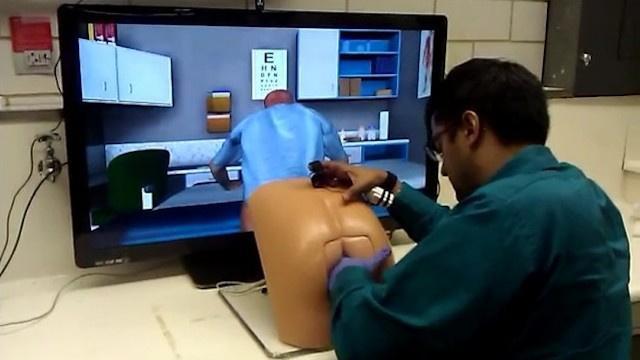
The future of prostate exam training is here, and his name is “Patrick.” Half sensor-embued tush-model and half computer-simulated cartoon-man, Patrick promises to grade medical students on their technique while also “present[ing] a realistic patient encounter” including “software that enables him to interact emotionally with the student.” (Before the exam begins, he tells you how scared he is.) [via Medical Daily]
Atul Gawande4, writing about useless medical care for the New Yorker:
One major problem is what economists call information asymmetry. In 1963, Kenneth Arrow, who went on to win the Nobel Prize in Economics, demonstrated the severe disadvantages that buyers have when they know less about a good than the seller does. His prime example was health care. Doctors generally know more about the value of a given medical treatment than patients, who have little ability to determine the quality of the advice they are getting. Doctors, therefore, are in a powerful position. We can recommend care of little or no value because it enhances our incomes, because it’s our habit, or because we genuinely but incorrectly believe in it, and patients will tend to follow our recommendations.
Interesting, in an otherwise thoughtful and well-written essay (as always), Gawande never once mentions fear of medical malpractice as a component that is driving useless healthcare utilization. His best anecdotal examples come from surgeons and proceduralists, who in private practice have an incentive to operate. The family doc, on the opposite end of the spectrum, doesn’t have a direct monetary incentive to order non-indicated radiological exams.
He also never mentions the “patient as consumer” either. Keeping private paying patients happy is the only real monetary incentive most providers have. The argument he references above is that doctors have the power and are (inherently?) inclined to over-test and over-treat. But anyone who has tried to not give antibiotics to someone with a viral URI knows that patients often go to the doctor to get what they want, not to find out what they need.
From a reader:
What’s your step by step process when answering questions on the NBME shelf exams? I have been reading the question first while highlighting the key words and then reading the answer choices (often glancing back at the words I highlighted to confirm that the answer choice I chose is correct.) With this method, I am sometimes pressed with time and tend to rush towards the end. Could you talk a little about your approach to questions on the shelf?
In the past, I’ve written about some of the ways I break down NBME and USMLE questions, but I haven’t actually written about how I really read one. That may be because the answer is relatively anticlimactic, but here I’ll talk a little bit about my focus on flexibility and speed over rigidity when it comes to approaching Step questions (with a few examples from the 2014 official sample questions). As always, this isn’t necessarily what you should do; it’s just my take. When I used to teach Kaplan MCAT, part of the “method” placed a lot of emphasis on using passage mapping as a consistent approach. If time management isn’t a problem for you, there’s no reason you can’t start/continue using these more involved strategies. But if you don’t have a big system and feel left out when you’re friends are fervently highlighting and using answer-choice first schemes etc, you’re not alone.Read More →
Update 8/5/2015: They’ve now updated to the new 2015-16 question set and removed the old links (they’ve previously kept the old ones working for several years). You can still access cached versions of 2014-15 and 2013-14 for now (cachedview.com is helpful in cases like these). My explanations for the new set are available here.
Here are the explanations for the updated 2014 (effectively 2014-15) official “USMLE Step 2 CK Sample Test Questions,” which can be found here.
Overall, there are only three new questions when compared with last year’s set (#90, 95, and 104), which I’ve marked with asterisks below. The explanations for the earlier 2014 set (effectively 2013-14) set can still be found here (the question pdf is still available online) and are largely identical (though in completely different order).
From Julia Belluz’s portrait of Dr. Oz in Vox, now apparently America’s most famous and most trusted physician:
This setback didn’t slow down Oz in his study of alternative medicine — or his embrace of fame. In the early 2000s, he worked with a reiki healer named Raven Keyes. She told me recently, “My reiki master is the archangel Gabriel. All I have to do is ask Gabriel to activate all the angels, and everybody’s angels come to life.” In the operating room, she said, she’d perch on a stool behind the anesthesiologist and transfer her good energy. “I’m connecting with the divine light within me and allowing myself to absorb the divine light in myself so it expands outward.”
Dr. Oz embodies the tension between personal freedom and professional responsibility. If one-way communication via a television or radio show doesn’t qualify as medical advice or constitute a physician-patient relationship, then how do we define it? Because anecdotes are apparently not uncommon about people who trust Oz via TV more than their actual physicians:
One reported that her dad had a heart attack and five stents placed in his heart, which required him to take aspirin and Plavix to prevent blood clots. “He was watching Dr. Oz, who said Plavix was not necessary, so he stopped taking it. About a month later, he had another massive [heart attack] and coded and had to be shocked back to life.” She continued: “My dad admitted to following Dr. Oz’s advice and not asking his own cardiologist.”
When a personality like Oz speaks about health and is a physician, he or she is essentially doling out medical advice. But right now, we wouldn’t even consider holding them accountable. Oz doesn’t even need to disclose his COIs when it comes to fat busting green coffee bean extract or other natural miracles.
Update: John Oliver weighs in on the most recent Oz controversy, as Oz responds to his critics who want him off Columbia’s faculty.
https://www.youtube.com/watch?v=sXTgxkhHAqo
And if you haven’t already seen it, Oliver’s awesome original Oz segment.