Skip to the content

Ben White

  • About
  • Archives
  • Asides
  • Support
    • Paying Surveys for Doctors
  • Medical Advice
    • Book: The Texas Medical Jurisprudence Exam: A Concise Review
    • Book: Student Loans (Free!)
    • Book: Fourth Year & The Match (Free!)
  • The Girl and the Unicorn
  • Radiology Jobs
  • #
  • #
  • #
  • #
  • About
  • Archives
  • Asides
  • Support
    • Paying Surveys for Doctors
  • Medical Advice
    • Book: The Texas Medical Jurisprudence Exam: A Concise Review
    • Book: Student Loans (Free!)
    • Book: Fourth Year & The Match (Free!)
  • The Girl and the Unicorn
  • Radiology Jobs
  • Search
  • #
  • #
  • #
  • #

Thoughts on studying in medical school

09.26.16 // Medicine

Let’s start with this premise: In the 21st century, the medical school basic science curriculum is probably best learned through guided self-study and likely not whatever your school is trying to teach you (especially if that involves the blind leading the blind via TBL). How much you can fulfill this ideal will unfortunately depend on how cooperative your school is with reality.

Read More →

Nothing > Fitbit

09.23.16 // Medicine

Among young adults with a BMI between 25 and less than 40, the addition of a wearable technology device to a standard behavioral intervention resulted in less weight loss over 24 months. Devices that monitor and provide feedback on physical activity may not offer an advantage over standard behavioral weight loss approaches.

That’s the conclusion of a 2-year 471-participant randomized controlled trial in JAMA of how wearable tracking technology affects weight loss.

Wrinkles: Only 75% completed the study. And both groups did lose weight: 3.5 kg in the “enhanced intervention group” and 5.9 kg in the control.

One wonders if meeting your goals with a wearable might cause some people to skip working out or quit an exercise session earlier than they might otherwise do (at least on occasion). The study also didn’t use one with any of the gamification principles that some people have promoted as making exercise more “fun.”

The public would prefer you to not be tired

09.20.16 // Medicine

The public apparently likes the 16-hour shift cap:

After people hear arguments both in favor and against eliminating the 16-hour shift limit, voters’ opposition holds firm at 86%, 79% strongly opposed,” she said. “Eight in 10 would support decreasing the shift limits for second-year residents from 28 hours to 16 hours as well.

These are results from a probably biased Public Citizen survey, a group that vocally opposes the FIRST and iCompare trials that are testing loosening the shift restrictions in surgery and medicine programs across the country.

What I find confusing is that the contemporary discussion always centers on whether or not shift limits are good for residents and/or for patient care. But this focus is always on the impact of shift length on acute fatigue and sleep-deprivation. Nothing about total shift burden, especially when you know that the residents in these studies aren’t magically conforming to the 80-hour rules that are frequently ignored.

I don’t know about most residents, but one imagines a physician to be a lot more likely to do okay on a long shift if (s)he weren’t chronically fatigued working 80+ hours a week. The focus on shift length I think misses the larger and probably more important issue about general overwork, burnout, and chronic fatigue. It’s like being worried about how fresh the oil is in a car without a transmission.

2:1

09.09.16 // Medicine

For every hour physicians provide direct clinical face time to patients, nearly 2 additional hours is spent on EHR and desk work within the clinic day. Outside office hours, physicians spend another 1 to 2 hours of personal time each night doing additional computer and other clerical work.

That is the conclusion of a paper just published in Annals of Internal Medicine.

Outpatient doctors spend at least twice as long proving they provide medical care for billing and compliance purposes as they do actually providing it. “To Err is Human” is more apt than the IOM ever realized.

MEDSKL

09.02.16 // Medicine

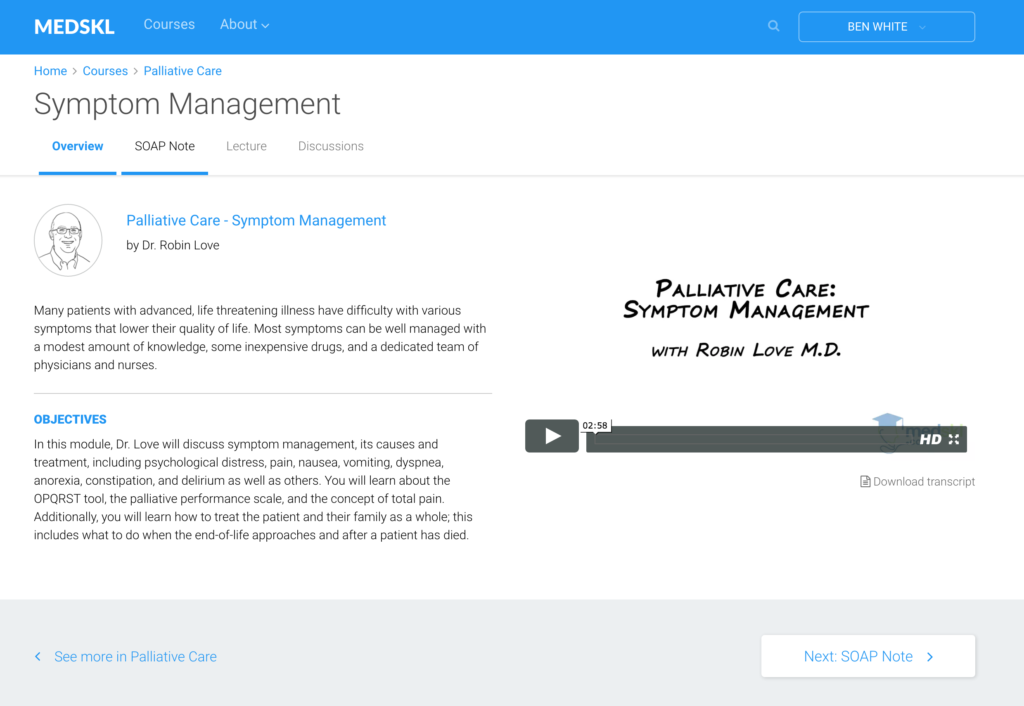
MEDSKL is a new free medical education site with a much greater than average pedigree. It’s a group of 180+ physicians/professors/faculty from medical schools in the US and Canada who are promoting FOAMed (free and open access education) for medical students.

Screen Shot 2016-08-31 at 12.42.16 PM

Its clinical (not basic science) focus is well-suited to third and fourth (and industrious second)-year medical students with brief animated videos, written lectures formatted in a SOAP note format for specific problems (clever), and video lectures. The handful I sampled were polished, high quality, and at a basic unintimidating level.

The educational content is all free. There are a lot of fields represented, but this is clearly a work in progress, and lots of topics have only token coverage. In the future, a paid account will net you self-assessment quizzes, which I imagine is the business model to sustain the project. There are also plans to add official CME this fall.

It’s probably a lot easier to recruit educators for clinical medicine presentations that they’re passionate about than it is to find good basic science educators, who are rare. We now have MEDSKL joining OnlineMedEd in the free clinical medicine lecture series, but no one wants to touch the boring parts of medical school (for free). Still, it’s only a matter of time until these sorts of platforms grow and mature.

I’ve long said that the non-clinical parts of the medical school could be a correspondence course. With the increasingly professional and multimodality online resources available, often for free, this is becoming more and more true. There will be a time not long in the future when the vast majority of schools will have basically nothing to offer students during the basic science years that they can’t get better somewhere else other than friends to commiserate with, a rigid schedule, and an external source of accountability. The current trend of supplanting lectures with TBL/PBL curricula isn’t going to change that one bit.

Step 1 Score Correlations

08.29.16 // Medicine

People often ask me about Step 1 corrections, particularly with regards to the Free 150 120 (for which I’ve posted explanations for several years). The data I’d come across over the years was super old.

Last month, Reddit user Waygzh posted the results of a 208 person survey (with an above average mean score of 245), which includes correlations for UWorld, the Free 150, multiple NBMEs etc.

The spreads are huge and the correlations not particularly good, but it’s the best you’re likely to get. Just don’t get discouraged if the number you see isn’t the number you want. Inspiration is better than deflation.

UPDATE: There’s now a 2017 Reddit survey available here as well.


The movement to end Step 2 CS

08.22.16 // Medicine

If you hadn’t heard, there is growing movement to end Step 2 CS (because it’s a stupid, expensive, and ultimately ineffective test). You can read about the background and sign the petition here. There’s also a fun additional JAMA editorial.

  • 20,190 MD (ignoring DOs who mostly don’t take it and IMGs, for whom the test was originally designed) students took the test in 2014-15, of which 96% passed. So 807 failed.
  • 817 MDs took a repeat and 86% passed (presumably 10 of these were third attempts or re-attempts from the previous year).
  • So 114 US MDs were caught by the Step 2 CS hurdle, at the maximum.

So that’s a terrible value proposition: offloading an expensive test offered in a handful of locations to students drowning in debt and short on time in order to catch a relative handful of people in a deficiency that is largely contrived. But what happened to those 114, of which half failed for communication skills and half failed for poor [fake] “clinical” skills? How many students are actually prevented from continuing their careers? And for students that fail and then pass (the vast majority), is there any evidence whatsoever that this process has improved their skills?1This would also apply to the other Steps of course, but CS stands out as being more subjective, less predictable, and thus more frustrating for the students who fail.

I am very curious about the former question. I strongly suspect the latter is completely absent.

The irony is that there are plenty of bad physicians, but none of this testing is well suited to unmasking and dealing with real world deficiencies. The even sadder wrinkle is that there are also clearly physicians in the US who have insufficient English skills to practice medicine properly, so Step 2 CS isn’t even doing what it was originally designed to do well.

If I were an MS1, I’d be praying this momentum snowballs and I could save myself the hassle and additional debt.

Qbanks & USMLE success: optimism, excitement, and joy

07.11.16 // Medicine

This post is adapted from a response to a reader email. There’s a special kind of question I get a lot of every spring. The format is always the same: there is an unmet goal or stagnated improvement on a qbank during dedicated board review with a subsequent ton of anxiety about succeeding on the test. This is a common, frustrating, and scary situation for lots of students. The fact is that not everyone will meet their goals, but that doesn’t mean that you shouldn’t optimize your attitude and approach. It deserves as much if not more attention than picking your resources or schedule (things that people have no problem agonizing over ad nauseum).

You need to start by not beating yourself up. Your specific goal—whatever it is—is awesome, and I hope you get it, but you need to know that goals are only helpful as a means of motivation—not something to tie your entire self-worth into. A misconstrued or stringent goal can be demoralizing and thus does not serve you well. A friend’s stated performance, posts on SDN—absolutely none of that matters to your personal needs.

Don’t let demoralization prevent you from utilizing practice questions as a primary component of your preparation. The reason UWorld and other qbanks are good tools is twofold. 1) Your knowledge is only helpful if it helps you answer a question. The best way to see how to apply your knowledge to a question is with a question. 2) The explanation teaches you both the correct facts, the ancillary facts (incorrect choices), and the context/test-taking/pearls/trends/etc.

Stop and consider why you feel sad when you review your performance after finishing a qbank section. Because being optimistic and believing in your strategy are important components of getting through this tough period and gaining/maintaining your momentum.

A lot of people shortchange themselves on point #2. They get upset when they get a question wrong and don’t use it as a learning opportunity. You should almost want to get questions wrong, because then it means you have an opportunity to improve, a potential blind spot to weed out. There are lots of reasons to get questions wrong and you need to approach the explanations as a chance to learn, not a chance to be disappointed. When you get questions wrong, flag them and do them again.

The other thing students do is use that negative emotional valence to overread the explanation. They take an exception and turn into a new rule. They try to generalize too much. They take something specific to one question and apply it to other questions where it doesn’t apply (“but last time I guessed X and it was Y; this time it’s X, wtf!”). All of this comes from stress and self-doubt.

The way to not burn out is to try to actively switch your attitude from fear to excitement. You’re doing this so you can learn, and, in a few weeks, you’ll be done. That is astoundingly exciting. It’s a huge milestone. When you start feeling amped up and nervous, you need to say “I am excited.” Excitement and panic are both states of heightened arousal, and they’re more similar than you’d think. Whenever you feel the panic rising, whether after a section on the qbank or the real thing, don’t “forget” that you’re actually excited.

If you don’t have much trouble with time management, I’d continue using tutor mode for the vast majority of your dedicated studying. Remember, the qbank is primarily about learning first and emulating the test day experience second. Stop paying attention to how you’re doing as you go through a section. Whether you do bad or good or your score changes doesn’t matter. This is how you’re going to study and you’re going to embrace it. Use books to supplement as needed when an explanation isn’t enough, need another perspective, or you hit something that requires re-memorizing a table (cytokines, glycogen storage diseases, things of that nature). You can switch to timed blocks to simulate the exam the last week and get into a groove. Find the confidence to go with your gut, not agonize, not get stressed by a long question stem, etc. If one particular thing seems like you’ll never learn it, then don’t. Your score doesn’t hinge on a single topic. For most people, there’s plenty of other material to learn instead.

Don’t forget that Step 1 should be a happy time. It’s the culmination of another chapter of your life and marks the transition from seemingly endless book learning to finally starting your journey in clinical medicine.

You need to study, do your best, and be proud of yourself.

Letter to a Third Year

07.06.16 // Medicine

I stumbled across this in my Google Docs. My school used to put together a book of letters every year from third years at the end of their year to give to students about to start clinical clerkships. This was written in 2011 (I still largely agree with myself).

Long before the end of third year, people will start talking about boring or interesting patients or about scut work or about the grind of clinic. Most of us probably wondered at some point during second year how long it would take us to be comfortable enough to feel bored. The beauty (or the bane) of third year is that each time you are comfortable enough to feel bored, your residents switch, or you change clinic or team or hospital or clerkship. You have just enough time to say, “hey, I’ve got this,” and then you’re on to the next adventure. It’s at least mildly frustrating, but then at some point you’ll come to this realization: If I’m bored today, that means I’m comfortable today. And that means I can do this.

And at first it might take six weeks, but then it’ll be three weeks, and then a week, and then maybe just a few days. You’ll be a little less impressed (or scared) of attendings and residents and maybe even disease, because when you show up to work and see your patients and write your notes you’ll realize that at this stage of the game you don’t need to be scared anymore. That looking back that some of those fresh interns on July 1st didn’t know much more than you did and were probably twice as scared. That you’ll always have backup. That the majority of patients you see will have the same common problems and that common problems can be diagnosed and treated once you’ve done it a few times. Then there are the “interesting” cases, the tough ones, the demanding attendings, and the fascinatingly rare zebras–and all of that is great, especially when you can help–because they keep things fresh. Hopefully at that point, the individual wrinkles that each patient has can stand out, and that’s what makes practicing medicine worthwhile. The people.

But when you first start and you’re scared and you know full well that you can’t do a history or a physical (let alone both at the same time), don’t worry. You’ll be fine. We all were.

Explanations for the 2016-2017 Official Step 2 CK Practice Questions

07.04.16 // Medicine

Here are the explanations for the updated 2016-17 official “USMLE Step 2 CK Sample Test Questions” PDF, which can be found here.

Overall, the June 2016 update removes 21 questions as a result of the decrease in block size taking effect this year. There are exactly two new questions in this year’s set (#19 and #117), but the question order has been completely scrambled. The explanations for last year’s set can still be found here (I’ve expanded a few of the repeat explanations, just for fun).

Helpful reader Jarrett has made a list converting the question order from the online FRED version to the pdf numbers.

Read More →

Older
Newer