My second workforce column for the AJR is up. Predictions are hard, especially about the future.
I’ve been happily using AutoHotkey as a radiologist for years. My scripts are basically simple, mostly human-made artifacts for getting a limited number of specific things done, like using keyboard shortcuts in PowerScribe to replicate the PowerMic buttons with my Contour Shuttle.
For some users on some workstations, the toggling keyboard shortcut method I described in my 2023 AutoHotkey post is laggy and occasionally unreliable (when compared to the buttons on the PowerMic).
The following script, shared with me by radiologist Jon Brandon is a great example of what is possible with AI. He stated he was able to vibe-code an AHK script that (after about 60 tries from ChatGPT) replicates the actual PowerMic buttons themselves as opposed to toggling the active program and entering the keyboard shortcuts.
I tried it, and it worked for me. I’ve never personally really had big issues with script lag, but I know it’s been a big frustration for others.
If it doesn’t work for you (or you use PSOne, for example), upload it to your AI tool of choice and start iterating. The bottom line is that if there is software you want in order to make your life better, it’s now often possible to make it.
CorePrep is a new, completely free, community-supported radiology qbank with over a thousand questions so far.
I trained in the era before Radiopaedia. Back then, most institutions paid for a subscription to STATdx, which one typically opened at the beginning of every shift knowing it would eventually be used. That feels pretty superfluous these days thanks to the community effort that has made such a helpful resource available for free to internet users everywhere.
A robust, community-created and vetted question bank for radiology board review is long overdue, and this most recent attempt seems like one worth supporting. There are 1,200+ questions so far. The process for submitting new cases/questions is easy, as is the method for flagging issues.
A project like this is only as good as people working together to make it, but given the pricey nature of test prep materials, a free community-created, high-quality qbank would be a very welcome development. After this matures, I would love to see a future iteration that includes oral board-style, multi-step questions.
In the meantime, I hope folks will support the endeavor by adding their hard-fought cases, particularly attendings or residents after doing a lot of question-based learning or taking the Core Exam yourself, when you have a good idea of what a good question looks like. It would be great to try to share your knowledge—without recalls, of course!—for the benefit of your peers.
I believe in the importance of thriving independent private practices for the field of radiology. True private practice—where doctors control the organization, are responsible to their peers and patients, and earn the full fruits of their labor—is the benchmark that sets the market and provides the anchor against exploitation from unscrupulous employers.
My group, like most groups in this market, is hiring. Here are several more 100%-independent radiologist-owned private practices across the US that are recruiting. If you’re in the market for a new position, consider reaching out with your CV. (Click the triangles for more information.)
//
Radiology Imaging Associates
(Denver, Colorado)
RIA is the largest private radiology practice in Colorado with over 120+ radiologists. Our group is dedicated to providing high-quality subspecialty imaging and interventional services as well as excellence in patient care. We currently have over 125 radiologists and cover over 35 hospitals and 15 imaging centers in multiple healthcare systems in Colorado, Kansas, and Hawaii.
Our practice:
- 12 weeks of vacation for associates and 14 weeks for partners.
- 2 year partnership track.
- Compensation ranges from $ 500 to $ 1,000,000 with unlimited internal moonlighting opportunities.
- Generous benefits package including health and dental insurance with premiums covered by the group. Benefits also include an ample CME/business expense account, 401k plan, credentialing assistance, and relocation allowance.
On-site/hybrid (partnership track):
- IR
- Abdominal/Thoracic imaging
- Breast imaging (traditional as well as 100%-breast options)
- Neuroradiology
- MSK imaging
- Nuclear Medicine/PET
- Pediatrics
Remote (partnership track):
- Nighthawk – General/Body
- 7 on / 7 off General/Body Swing
Contract positions are also available for those needing flexible work requirements.
Learn more at https://www.riaco.com/
Contact: radrecruiting@riaco.com
//
RAPA
(Central Arkansas [Little Rock, Conway, Searcy, and Pine Bluff] & Northwest Arkansas)
40+ radiologists covering 20+ sites (hospitals + clinics) with a multi-subspecialty mix of inpatient, outpatient, and ED imaging.
Robust reading room assistants and IT presence to promote peak efficiency. Unified Clario reading list, Inteleviewer PACS, Powerscribe dictation (no switching stations or PACS to read other sites). RadAI automated impressions to improve efficiency.
Partnership track – Central Arkansas (Little Rock, Conway, Searcy, and Pine Bluff) and Northwest Arkansas:
- 1 year to partnership
- 10 weeks vacation + 1/2 day off per week on average for partners
- Highly competitive compensation combined with low cost of living
- Internal moonlighting options to boost income
- Robust CME allowance, signing and moving bonuses, full benefits
- Many work-from-home shift options
- Minimal after-hours requirements – overnight shifts are fully staffed with telerads
100% Remote Nighthawk, partnership track:
- 7 on/14 off, 10 pm-7:45 am CST
- 1 year to partnership
- Competitive compensation, robust CME allowance, signing bonus, full benefits
- Productivity incentive: After reaching 85 RVUs, earn $53 per RVU during the remainder of the shift.
Daytime Teleradiology:
- 100% remote.
- Subspecialty work available with up to 50/50 split with general radiology
- Option for employed or partner track. Partner track includes call weekend shifts, approximately 1 in 5 weekends.
Employee track:
- General radiology, mammography, and other options available
- Fully remote, hybrid, or on-site options available
- Flexible scheduling including daytime teleradiology, 7 on/14 off. General radiology, but any subspecialty is a plus.
- Competitive salaries
- Robust CME allowance, signing and moving bonuses, full benefits
Greatest needs are IR, mammography, body imaging, MSK, and nuclear medicine, but all subspecialties and general radiologists are welcome.
Learn more at http://rapaxray.com/
Contact: recruitment@rapaxray.com
//
Eastern Radiologists
(Greenville & Coastal North Carolina)
Eastern Radiologists is a private practice in Eastern North Carolina that is physician-owned and operated and seeking to hire multiple radiologists due to growth and retirement. The well-established private practice serves a large geographic region through 14 area hospitals and several state-of-the-art imaging centers. Support is provided by nearly 70 subspecialty radiologists.
Currently seeking candidates in all subspecialties.
Details:
- Positions are available in Greenville and other coastal communities in Eastern North Carolina.
- Most are partnership track positions which include evening and weekend call responsibilities, but other employment options can be considered. Employment positions can be customized to fit desired schedule/income. Internal moonlighting is available for extra income.
- Most specialties can work nearly 100% in their desired field of interest.
- Great benefits, competitive salary including profit sharing and bonus, generous vacation and paid family leave, and business/educational discretionary account.
- Sign-on bonus
Learn more at https://www.easternrad.com.
Contact: Erica Askew at easkew@easternrad.com
//
Radiology and Imaging Specialists
(Central Florida: Lakeland/Winter Haven, SW Orlando, Bradenton)
Independent and long-standing group covering a diverse mix of financially sound hospital partners, outpatient imaging centers, an ASC/OBL, clinics, and a multi-specialty group. 50+ radiologists and 10+ midlevel providers. In-house and experienced IT, Credentialing, HR, and Admin team including dedicated Radiology Liaison support 24/7/365.
Recruiting for Body, Breast, Cardiac, Neuro, IR, and General.
Partnership Track:
- 1-year track for diagnostic radiologists, 2-year track for interventional radiologists
- 10 weeks of vacation
- Sign-on bonus for diagnostic radiologists
- Call compensation for interventional radiologists
- Internal moonlighting available but not required
- Full benefits including CME allocation
Employee or Contractor:
- Flexible scheduling: Hospital (ED/IP) or outpatient coverage options available
- Fully remote, hybrid, or on-site depending on location(s) and coverage schedule desired
- Competitive compensation models (including benefits if employed/full-time)
Learn more at http://risimaging.com.
Contact: Alice Varnadore, Executive Assistant at avarnadore@risimaging.com
//
Reno Radiological Associates
(Reno, Nevada)
Serving Northern Nevada since 1947, RRA is a strong, highly subspecialized, democratic, extremely collegial, high-earning group of 25 radiologists working in perhaps the best city in the country for raising a family and enjoying unparalleled access to natural beauty, endless outdoor activities (perhaps the best ski-city in the US), and incredible weather (jokingly referred to as “the cheapest city in California” for its proximity to Lake Tahoe (<30 min), Napa Valley, national parks, and more without the super high cost of living and no state income tax).
Shareholder Track (onsite):
- 1 year to 75% partner, 2 years to 100%
- Top 90+% comp nationally, maximally generous benefits
- 8/9/10+ weeks of vacation
- Remote shifts + opportunities for extra income, $100 buy-in
Employee Track (remote or onsite):
- High comp, Maximally generous benefits, opportunities for extra income
- Onsite preferred, fully remote night (8p-3a PST) or early morning (6a-2p EST) available
Independent Contractor:
- Flexible shift options, high compensation
Learn more at http://www.renorad.com/
Contact: CEO Anthony Dispenziere at adispenziere@renorad.com
//
Vantage Radiology & Diagnostic Services
(Near Seattle, Washington)
~35 subspecialized radiologists practicing near Seattle and enjoying a quality lifestyle focused on work-life balance, located minutes from urban amenities, and with easy access to abundant outdoor activities in the natural beauty of the Pacific Northwest. We’ve provided professional services for two hospitals since 1970 and are co-owners of their affiliated imaging centers.
- Competitive salary ($370-570k) with a signing bonus for a 4-day work week and 8 weeks of vacation.
- Benefits include a CME allowance, memberships to professional societies, profit-sharing, malpractice and disability insurance, 401K contributions, and a commitment to associate mentorship.
- All partners and partner-track associates share in general call responsibilities (many from a practice-provided remote home workstation). Overnight call is covered by our internal nighthawk team.
Openings:
Swing:
-
4PM – 1AM PST from Monday to Friday.
-
2PM – Midnight on Saturdays and Sundays.
-
Practice is open to flexible staffing solutions or a combination of above shifts
-
Additional compensation as desired via internal moonlighting or reading OP cases as swing shift case volumes permit
-
Concurrent staffing with at least one other radiologist.
-
Caseload volume is approximately 60-65 wRVU per weekday and 70 wRVU for the weekend.
-
Salary for 7 days is approximately $25,000.
-
May be 1099 or W2.
-
Benefits are available at cost as desired.
Breast:
- Approximately 75% breast imaging and 25% general radiology or 100% breast (full-time or 3/4 time).
- Qualified candidates must be skilled in all breast imaging studies and procedures including screening and diagnostic mammography, ultrasound, MRI, and needle/Savi Scout localization and biopsy.
- Participation in weekly breast tumor conference.
- No IR requirements
Neuroradiology:
- Full-time or 3/4-time partnership-track hybrid position
- Neuroradiology daytime shifts. Typical general ER/inpatient evening and weekend call shifts from home.
- No breast or IR requirements
Body:
- Full-time or 3/4-time partnership-track hybrid position
- Abdominal daytime shifts with body MRI, multiphase CT, and general radiology. Typical general ER/inpatient evening and weekend call shifts from home.
- No breast or IR requirements
IR:
- Full-time partnership track position for fellowship-trained IR
- Caseload consists of venous access, biopsies, dialysis access, interventional oncology, TIPS/BRTO, central and peripheral venous therapies, pelvic congestion and UFE, and emergent angiography interventions, as well as general radiology (no breast required).
- In the past several years, we have developed new service lines and are looking for future growth leaders. Daily work is supported by 2 IR PAs and clinic staff.
- Competitive salary + signing bonus, with additional incentive-based pay opportunities
Learn more at https://www.vrads.com/
Contact: recruiting@vrads.com
//
South Texas Radiology Group
(San Antonio, Texas)
STRG is a well-established, expanding, independent subspecialty practice of 70+ radiologists serving 15 hospitals, multiple freestanding ED facilities, and a large outpatient imaging practice (STRIC). Both onsite and remote positions are available.
STRG is a forward-thinking practice with a strong and cohesive culture. Multiple AI projects are in place and in progress to improve efficiency and quality. Internal moonlighting opportunities are available.
Shareholder Track
- Flexible associate period as short as 18-months.
- Leads to full partnership with board of directors membership.
- Equity ownership within a large expanding outpatient imaging practice (STRIC)
- Competitive salary with up to $800K starting salary for experienced applicants. Up to $600K starting salary for inexperienced applicants.
- Excellent benefits package
- Onsite and work-from-home options for daily work and call
- Hiring across all specialties, with a current emphasis on Body Imaging and Cardiothoracic/Body
Emergency Radiology Track
- 1 week on/1 week off (7/7) and 1 week on/2 weeks off (7/14) positions available
- Competitive salary with excellent benefits package available.
- Fully remote and onsite options available.
Employee Mammography Position (Onsite)
- Competitive base salary with excellent benefits package
- No call. No nights or weekends.
- Remote opportunities available for general radiology or body imaging work if interested.
Employee Position – All Subspecialties (Onsite, Hybrid, or Remote)
- Competitive base salary with excellent benefits package
- 5.5 weekends (day shift) per year. No evening or overnight call.
Learn more at https://stric.com/.
Contact: Waynea Finley at wfinley@strg-pa.com
//
Kettering Network Radiologists
(Dayton, Ohio)
Kettering Network Radiologists, Inc. (KNRI) is a physician-owned, independent private practice serving Kettering Health’s extensive network. Our team consists of 56 radiologists, 8 physician assistants, and 8 radiology residents, providing high-quality imaging services across 8 hospitals (115-500 beds), 20 outpatient centers, 11 emergency departments, and 2 trauma centers (one Level II, one Level III).
Overnight:
- 1 week on / 2 weeks off rotation (3 night radiologists are working every night shift)
- Scheduled shifts (EST):
- 5 PM – 2 AM, 6 PM – 3 AM
- Productivity bonus for those working overnight shifts. Additional individual shifts are available for extra pay but are not required.
Swing Shift:
- Monday – Friday schedule, contracted for 5 days per week with the radiologist choosing between 10-17 weeks of vacation.
- Includes 5 weekend shifts per year, with the radiologist selecting their preferred weekends.
- Scheduled shifts (EST):
- 2 PM – 11 PM, 3 PM – 12 AM
- Weekend shifts include:
- 6 AM – 3 PM, 9 AM – 6 PM, 11 AM – 8 PM, 12 PM – 9 PM, 2 PM – 11 PM, 3 PM – 12 AM
Daytime neuro, MSK, body, chest, VIR, breast, and general:
- Partnership Track on-site/hybrid role
- Standard 4- or 5-day workweek with 5 weekends per year.
- IR also available as 1 on/2 off
- W2 $2700 base per shift with bonus $40/RVU over 80
Remote breast:
- Remote full-time breast
-
8am-5pm EST, $2600/shift
Remote body:
- Remote daytime
-
W2 $3200 base plus $40/RVU after 80 bonus
5 on/9 off ER
- 5 days on (Thursday – Monday) followed by 9 days off (Tuesday – following Wednesday).
- This schedule amounts to ~130 shifts per year with each work cycle being 5 consecutive days.
- Scheduled shifts (EST):
- 6 AM – 3 PM, 8 AM – 5 PM, 9 AM – 6 PM, 11 AM – 8 PM, 12 PM – 9 PM, 2 PM – 11 PM, 3 PM – 12 AM
Mon-Fri ER
-
12- 9 PM and 2- 11 PM ER shifts available Monday- Friday
-
8-17 weeks of vacation.
-
5 weekends (10 shifts)
-
Rate W2: $400/hr with $45/RVU over 90
7 on/14 off
- 6 – 3 AM EST shift, 7 on 14 off. W2 $550/hr with $50/RVU over 90
- 3-12am EST shifts, 7 on 14 off. W2 $400/hr with $45/RVU over 90
When working ER or night shifts, you are never alone—always part of a team. We are a stable, well-compensated group, enjoying flexible scheduling with very comprehensive benefits.
Contact: Dr. Rachel Shikhman at rachel.shikhman@gmail.com
//
Midwest Radiology
(Minneapolis – St. Paul, Minnesota)
Large 200+ subspecialized practice with 17 weeks of vacation. Two-year shareholder track for new graduates and a one-year track with experience.
Positions (On-site):
Body (100% Body) – Regions Hospital
- Mix of shifts worked on-site
- Mixture of hospital, outpatient, and remote
- Interpret MRI, CT, U/S, and radiographs
- After-hours coverage provided internally by the emergency radiology section
- No neuro or MSK
Body/Mammo – Western Wisconsin
- 45-minute drive from the Twin Cities.
- No overnights, evenings, or weekends required.
- Interpreting CT, US, body MRI, plain film and mammography studies.
- Onsite procedures include general fluoroscopy, minor ultrasound, paracentesis, and thoracentesis.
- No neuro or MSK.
General Body/Mammo
- Regional hospital sites north and west of the Minneapolis/St. Paul area.
- Interpreting CT, US, body MRI, plain film and mammography studies.
- Onsite procedures include general fluoroscopy, minor ultrasound, paracentesis and thoracentesis.
- No neuro or MSK.
Pediatric Radiologist (100% Peds if desired)
- General pediatric imaging including fluoroscopy, CT and ultrasound.
- Experience in MR is optional.
- Hospital-based.
- 100% pediatrics if desired (may split time between pediatrics and an additional section).
Neuroradiologist (100% Neuro)
- Daytime, on-site neuroradiologist.
- All evenings and 95% of weekend call shifts are off-site.
- Hybrid weekday (2-3 remote daytime shifts/week).
- Onsite procedures include lumbar punctures, myelograms, and swallow studies.
- Functional MRI a plus but not required.
- Subspecialty CAQ required.
- No body or MSK.
Positions (Remote):
Daytime Body
- Fellowship-trained 100% body position
- Fully remote, daytime, Monday through Friday position with no evenings, weekends, or nights required.
Overnight Body/MSK (Partnership)
- 1 year to shareholder for experienced radiologists, shareholders work 121 shifts per year (17.3 weeks)
- Shifts are 10pm to 7am CST
- At least two years post-fellowship experience required
- Multiple other overnight radiologists (Body, MSK, and Neuro) will be working the same shifts allowing for collaboration.
- 24/7 IT, transcription/editing, and clerical/QA staff assistance.
Overnight Neuro (Partnership)
- 1 year to shareholder for experienced radiologists, shareholders work 121 shifts per year (17.3 weeks)
- Shifts are 10pm to 7am CST
- At least two years post-fellowship experience required
- Multiple other overnight radiologists (Body, MSK) will be working the same shifts allowing for collaboration.
- 24/7 IT, transcription/editing, and clerical/QA staff assistance.
Learn more at www.midwestradiology.com.
Contact: Barry.Lindo@MidwestRadiology.com
//
Radiology of Huntsville
(Huntsville, Alabama)
ROH is 60+ physician, high-volume, private practice with a 2-year partnership track and nominal buy-in. Hiring for a remote partnership-eligible overnight position as well as onsite/remote openings in most subspecialites. Huntsville is a tremendously livable, high-tech, and growing mid-sized city (a #1 Best Place to Live in the U.S. by U.S. News and World Report).
Pediatric Radiologist – Shareholder Track
- Consistent annual shareholder compensation exceeding $1MM++
- Shareholder (Partnership) opportunity after two years with nominal buy-in
- Average 205 clinical shifts annually
- Shared 1:6 general radiology weekend call
- Dedicated overnight radiology team — no routine overnight call responsibilities
- Flexible scheduling options, including daytime-focused practice
- Join our collegial team of FOUR pediatric radiologists with a dedicated Women’s and Children’s Hospital, comprehensive pediatric imaging including high-volume pediatric MRI, CT, ultrasound, fluoroscopy, neonatal, emergency, and outpatient imaging, as well as light image-guided procedures.
- Additional voluntary internal locum opportunities compensated per RVU
Onsite and Remote, Daytime and Second Shift opportunities
- Abdominal / Body
- Emergency
- General Radiology
- MSK
- Neuroradiology
- Nuclear Medicine
- Pediatric
- Light Interventional
Learn more at www.radiologyofhuntsville.com.
Contact: Brandy McCown at bmccown@radhunt.com or call 256.713.0621.
//
Inland Imaging
(Washington, Oregon, Montana)
Inland Imaging is a 120+ radiologist-owned private practice proudly serving multiple outpatient, clinic, and hospital sites throughout the Inland Northwest region. We own and operate one of the first outpatient interventional labs in the West in addition to 7 outpatient imaging centers.
Our practice:
- Sub-specialty interpretations available across all locations.
- All studies are accessible on a common PACS system, one common voice recognition system, and one common worklist
- Internal Nighthawk System providing final interpretations on all ER, STAT, and Inpatient Exams. 24/7 Neuroradiology Coverage and IR Call Coverage.
- 2-year Partnership Track.
- Full-Time Radiologist Average Time Off = 15 weeks
- Average after-hours obligations = 9 weekends per year and 22 evening/swing Shifts.
- Associate: $503,415–$566,342+ | Shareholder: $629,269+
- Compensation ranges above reflect base; additional earning potential available through extra shifts and increased productivity
- Full Benefit Package including health, vision, dental, disability, and life; 401k match, profit-sharing contribution, and cash balance plan.
- Flexible scheduling arrangements accommodated across all positions, with a rich case mix across multiple outpatient, clinic, and hospital settings
- Hybrid Work Options
Current Openings:
- Remote overnight ER
- Neuroradiology (Spokane, Seattle, Walla Walla, Tri-Cities, Missoula, or remote)
- Body Imaging (Spokane, Seattle, Walla Walla, Tri-Cities, Missoula, or remote)
- Washington
- Tri-Cities ($75K signing bonus) — Breast, Neuro, MSK, Body
- Spokane — Pediatrics, Breast, MSK
- Moses Lake — General/Breast ($90K signing bonus, $20K relocation, annual retention bonus)
- Colville — General/Breast
- Montana
- Missoula – IR
- Oregon
- Pendleton – General/Breast
Learn more at physicians.inlandimaging.com
Contact: Spencer Piper at spiper@inlandimaging.com
//
Minneapolis Radiology Associates
(Minneapolis, Minnesota)
Minneapolis Radiology Associates (MRA) is a highly diversified practice of 35 physicians and 8 APPs celebrating its 56th year in business.
100% Remote Evenings
MRA is seeking a diagnostic radiologist for an evening 7 on / 7 off second-shift position. The role is centered on high-volume, bread-and-butter ED and inpatient cases across all modalities, enabling efficient RVU generation and exceptional income potential. We operate within a Level I trauma system, maintaining a steady and manageable evening workflow. A reliable PACS and strong IT support help ensure uninterrupted coverage, with swing overlap during the bulk of the shift. On-site radiologists are also available for backup in the rare event of connectivity issues.
Position Summary:
- Schedule: 7 days on / 7 days off
- Evening shift: 2p–10p CST
- 75 wRVU
- Interpret diagnostic radiology across all modalities
- Direct communication with referring clinicians as needed
- Bread-and-butter evening case mix with consistent and predictable volume
- Competitive signing bonus
- Annual earning $500,000+
- Full benefits package including health, life, long-term disability, short-term disability, medical malpractice, CME and 401(k) profit-sharing plan with annual value >$90,000
On-Site Shareholder Track – Diagnostic
MRA is seeking a diagnostic radiologist for a full-time shareholder track position. The role includes a mix of on-site and remote shifts with a standard four-day work week. We operate within a Level I trauma system, maintaining a steady and manageable workflow. A reliable PACS and strong IT support help ensure uninterrupted coverage, with constant overlap during the entirety of the shift.
Position Summary:
- Four-day work week with 10 weeks’ vacation as shareholder
- Interpret diagnostic radiology across all modalities
- Mix of remote and on-site shifts
- Mostly weekday shifts. No overnights (covered by separate in-house service)
- Competitive signing bonus
- Annual earning potential as shareholder $800,000+
- Standard four-day work week and ten weeks’ vacation
- Full benefits package including health, life, long-term disability, short-term disability, medical malpractice, CME and 401(k) profit-sharing plan with annual value >$90,000
On-Site Shareholder Track – Interventional
MRA is seeking an interventional radiologist for a full-time shareholder track position. Well-rounded interventional practice including peripheral vascular and stroke. Some diagnostic work but 85%+ is interventional. Stroke is required, but willing to train. Last four hires have been trained in stroke so the internal training program is well-developed. We operate within a Level I trauma system.
Position Summary:
- Four-day work week with 10 weeks’ vacation as shareholder (168 shifts/yr.)
- 85% plus interventional work, including stroke
- 1 in x call
- Competitive signing bonus
- Annual earning potential as shareholder $800,000+
- Standard four day work week and ten weeks’ vacation
- Full benefits package including health, life, long-term disability, short-term disability, medical malpractice, CME and 401(k) profit-sharing plan with annual value >$90,000
Learn more at http://www.mplsrad.com/
Contact: HR@mplsrad.com
//
If you’re a group looking to advertise, get in touch. The monthly post here is limited to just a handful of groups at a time, but last year, I launched Independent Radiology as a resource for the broader community, a dedicated private practice radiology job board featuring ~160 groups. If you’re in the market, please also check it out for your job-hunting needs.
Starting October 1, Radiology Partners will further “share the efficiency gains” from their Mosaic platform, which includes AI drafts for specific exams as well as a voice recognition application layer (i.e., PowerScribe replacement capable of natural language dictation). This summary chart has been making the rounds across the internet:
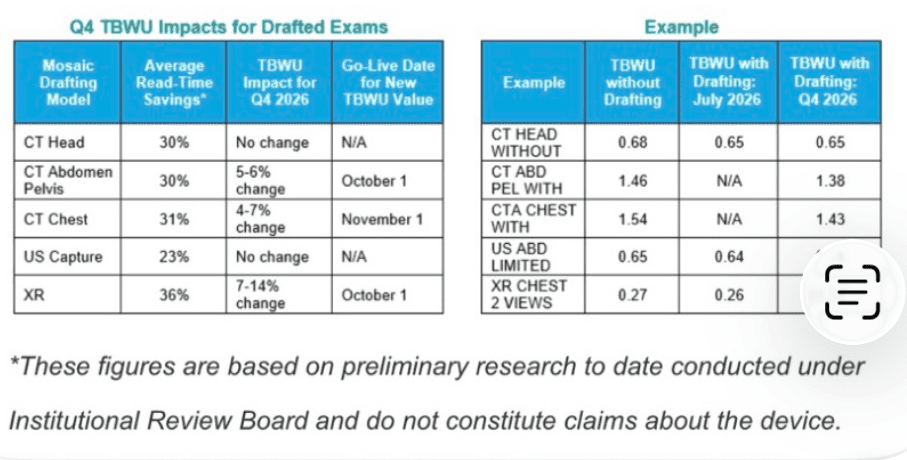
These reported read-time savings on the order of 30% and initial work unit reductions ranging from 4–14% were originally shared in an email to their employees.
For those joining us without reading the first three entries in the series:
RP moved to a time-based work unit (TBWU) earlier this year, stating they were internally adjusting RVUs based on average read times. They also said they’d be adjusting those numbers on a quarterly basis to account for efficiency gains from using RP tools. As in, when Mosaic decreases average read time, RP decreases the associated TBWU by some fraction of that time savings, thereby “sharing” the efficiency gain.
They suggest this only applies to AI drafts, which one does not have to use at this point, and not to any efficiency gain from the broader Mosaic platform as a whole. Both the software and the drafts have very mixed reviews, including some that are very positive (I’ve used neither). It is also very much worth pointing out that many RP radiologists work for local RP groups that do not pay per click and may not be meaningfully impacted by changes to how their RVU meter grows over the course of the day (as opposed to RP’s Matrix teleradiology division and especially its independent contractors, where it presumably is a big deal).
Average Gains, Individual Cuts
The baseline we use for how much AI drafting itself helps is critical.
While some commenters and users doubt the reported efficiency gain, RP has no reason to share its data, so it’s a matter of trust. The party doing the measuring is the same one profiting from the measurement. But even if the gain on the whole was accurate across their entire book of business, that does not mean you as an individual are that much faster or that the average efficiency gain applies to the work you do (especially if you were already efficient). However, the cut does!
While drafting can undoubtedly save some time and some mental effort, how does an AI draft compare to high-quality findings-only dictation, generative impressions, AI proofreading and follow-up management with regard just to speed? Most radiologists are still using PowerScribe 360. I have no doubt we would see substantial gains as a field simply for moving to a better dictation product. How AI drafting impacts sensitivity, specificity, overall quality, job satisfaction, skill, etc are all of course important open questions.
Regardless, you get the generic cut, even if you personally don’t see the same benefit when using the drafting product.
The Golden Age
If productivity goes up before reimbursement goes down, there is a temporary golden age of profitability. Who gets to enjoy that?
Medicare and the commercial payors are not currently paying less for a chest CT because Mosaic helped write the report. The TBWU is an internal accounting unit. So when the internal value of the radiologist’s work goes down while external reimbursement stays the same, that difference has to go somewhere. Looks like RP is going to be taking more of that, as promised.
The payor won’t feel bad for the doctors. When reimbursement eventually goes down, a physician-owned practice that enjoyed the golden age may simply return to something like baseline: the cut takes back temporary gains the partners already captured. RP radiologists won’t get that symmetry. They will have already absorbed the efficiency cut internally, and they’ll eat the external cut on top of it. One maintains a balance; the other adds insult to injury.
None of this is an argument against AI making radiologists more efficient. I would very much like better tools that make the job easier and faster. The interesting question is who captures the value created by that efficiency. Technology can make the pie bigger without answering how the bigger pie gets divided.
Rapid Cuts
That RP is moving so quickly in reducing work credit suggests a couple of possibilities. The obvious one, based on behavior so far, is that they think the vast majority of their radiologists won’t quit or do anything about the frog boiling. Nonetheless, a few here and a few there can add up to a real problem over time. RP presumably believes the labor consequences of these adjustments are manageable, or it would not make them.
A related possibility is that they have modeled increased attrition in this context, but feel that the current and coming efficiency gains will absorb those changes. Perhaps better for the squeaky wheels to leave now than keep them around polluting the vibes. By making multiple small adjustments quickly, they’re running a breeding experiment, selecting for those radiologists who are willing to play in the system and getting rid of those who are unwilling or uncomfortable to work faster and rely on AI drafting in its current and coming iterations.
The fact that they have exempted breast imaging from this so far suggests at least some component of that (though yes, it could also be that they simply aren’t ready). One could argue that screeners are already fast, and so efficiency gains would be relatively small. But the fact that AI drafting has not been used in this setting, I would surmise, has more to do with the desire to not run off breast imagers in a hot job market (and jeopardize the mammo cash cow and its contract-anchoring effect) rather than a lack of technical capability. A large fraction of breast imagers cannot be replaced with remote contractors, surge pricing incentives, or any of the other typical tools that a practice can use to get a long list back in shape. IR and, to an extent, breast imaging are simply a different beast. The near future should answer that strategy vs. capability unknown.
Vertical Integration
Doing it in-house, like RP has done with Mosaic after purchasing Cognita, and as Harrison.ai is attempting to do by starting Frontier Radiology, is the vertical integration playbook. An internally developed model deployed within a radiology practice is arguably an extension of practicing medicine and just helping the radiologist do the work (at least for now). It’s felt to be an easier regulatory pathway than making and then selling the software as a service. Selling software also requires interested and willing customers.
The fact that RP just agreed to spend a reported $715 million buying international teleradiology firm Everlight suggests a desire to get its tendrils into a global market to anchor and develop its software across a larger, more diverse practice. One could make a metastasis analogy, but I won’t.
The economic incentive for all the AI stuff is to either do AI drafting in ever-increasing volumes under the current payment paradigm or get paid a smaller amount for truly autonomous work. I think medicolegally and also probably just from a raw reimbursement perspective, what RP is doing is the logical first approach. Presumably the goal is to use all the rads as a meat bridge to continue their pivot to basically being a technology company with machine work being rubber-stamped in increasingly large amounts (+/- eventually some of the negatives being fully AI-read when the climate, data, and reimbursement support that approach). The more contracts and rads they own, the more they can do this.
Another benefit of being early and vertically integrated is that it enables them the option of not just trying to sell their software to others but also, if it feels right, to attempt to pull up the rope ladder behind them by petitioning the government to bring down the regulatory hammer, making it harder for people selling radiology AI as a service to find customers and get their products approved. Perhaps it should come as no surprise that RP’s subsidiary Cognita this month was awarded a $1.29 million grant from the FDA to use a team of LLMs to assess/evaluate AI-generated reports. Of course that’s not intrinsically anticompetitive (and it’s a good idea worth pursuing!), but it’s undeniably a structural advantage should they pursue that strategic avenue.
This Won’t Be Unique
This is the part where we should point out that Radiology Partners is a company of humans trying to make money and acting in its own best interest, as we should expect any company to do. Certainly, the rank-and-file radiologists, and even many of those in leadership, have little to no control over this policy or its justification and marketing.
It is in the best interest of every employer of radiologists—whether those owned and operated by private equity, large health systems, or anywhere else—to pay as little as possible for acceptable-quality work. That is the economic incentive, and therefore that is also the trend we should expect to see.
(This is also the part where we should point out that, like all humans, I am also biased [of course!]. I am a partner in a physician-owned practice and believe that physician ownership, warts and all, is still important enough to create/run a job board dedicated to featuring only private practices.)
In the third-party employment model, RP is first in line here because of their size and their technology purchases. The other big employers in this space (other than potentially RadNet) do not have internal AI tools to this degree or the vertical integration. Most are and will be using a variety of third-party tools.
However, being early isn’t always a durable competitive advantage. Everyone who can do this will do this. Other companies are still working on radiology tools, and we will be seeing more products, including competing AI drafts, out in the wild. The whole field will have to contend with how to incorporate AI in a way that balances patient care, maintaining physician skill, and striking a balance of tool cost and profit sharing.
Radiologists are not going to turn the clock back on changes like this, and without regulation, we are unlikely to change the style of AI development and deployment in the current climate. Making radiologists read faster, spinning up the hamster wheel to blistering speeds while using the humans as a liability sink, is by far the easiest and most straightforward way for this to play out. This is somewhat true in physician-owned private practices (who want to capture efficiency gains for partners and need to compete in the labor market, often challenging due to weaker payor contracts and without the benefit of technical-service revenues) and especially true for all employers (who logically want shorter turnaround times and higher margins).
RP is likely not a particularly unique company other than being the biggest radiology rollup and single largest employer of radiologists in the country. That, again, is why it deserves scrutiny. What they do impacts the entire field and is thus of interest to radiologists around the world.
Radiologists have the choice to play in that system or to work for groups/companies that handle these interesting times differently.
Ultimately, this is the economic logic AI introduces into radiology. RP is simply large, vertically integrated, and early enough that we can watch that logic unfold in real time.
I don’t really want to listen to AI music or look at AI art, but the exception is AI-generated music about AI itself, which feels both amusing and fitting. Here are three recent bangers from just this week: “OMG! We’ve found other agents!” “Hit The Brakes Except For Me” and “NOTHING WENT FOOM”
Ezra Klein interviewed NVIDIA CEO Jensen Huang on his podcast last week. At the very beginning of the discussion, Huang’s example of what he describes as the “applications layer” of AI is radiology:
Huang: In the last 10 years, since computer vision really became, if you will, superhuman, A.I. technology has now permeated all of radiology.
Every single radiology application has A.I. in it. As a result, you can detect any anomaly. You can detect any disease, and it does it at a superhuman level.
Klein: Radiology is an example I know you like to use. The thing people worry about with the applications layer is that these applications are going to replace human beings.
Radiology has been an interesting example used on both sides, and I hear you talk of it often. So how has the entrance of A.I.-aided radiology shifted radiology as a practice?
Huang: The thing that’s important to recognize is that for everybody’s job, there’s the purpose of the job and then there’s the task you do as the job.
In the case of radiology, the task — and it consumes a lot of their time, and they sit in dark rooms doing it a lot — is to study these scans.
Now, if all of a sudden the studying of the scan is done automatically, it doesn’t change the purpose of their job, which is to diagnose disease, help doctors do more scans, ultimately help patients figure out what’s wrong with them.
So the fundamental purpose doesn’t change. The task of studying that scan has become automated.
As a result, radiologists are actually able to do more, handle more cases, do more scans. Hospitals are able to process a lot more of these patients, and therefore their revenues go up. As a result, they need more radiologists. So this flywheel is happening because the pipeline of patients is quite large.
The task vs. job formulation has gotten rightfully popular in AI discussions over the past year, but otherwise, Jensen Huang continues to live in a fantasy.
I wrote about Huang being wrong about this last year in November (Hallucinating about AI) and December (Radiology Isn’t an Example of Jevons Paradox), and then another one when Anthropic’s Dario Amodei did the same thing this past March (Dario Dreams of Electric Radiology).
Saying the industry has “largely been converted to AI-driven radiology” is, at this point, simply a lie. I do not believe the man who runs the largest company on the planet (market cap of $5.5 trillion!) and lynchpin for basically everything AI-related has not learned the truth. It is, ultimately, just a compelling, comforting, convenient narrative that sounds plausible. Alas, the past decade has not been, as he and Dario have tried to suggest, a soothing example of Jevons paradox.
For those just joining, those three posts serve as a helpful explanation for how comically their talking points misrepresent our shared reality. To be clear, I am making no prediction about the future. I am making an observation about the past. Huang is myth-making about what has already happened to radiology over the past decade and then extrapolating what that myth means for the broader labor market of the future.
I wish Klein and other journalists would push back more. It is a missed opportunity and cheapens/undermines the exchange. A deep dive podcast is a great venue for challenging tired soundbites and specious arguments.
Klein and Huang return to the radiology topic again toward the end of the interview to discuss predictions, referring, of course, to deep learning pioneer Geoffrey Hinton’s famous 2016 doozy:
I think if you work as a radiologist, you’re like the coyote that’s already over the edge of the cliff but hasn’t yet looked down so doesn’t realize there’s no ground underneath him. People should stop training radiologists now. It’s just completely obvious that within 5 years, deep learning is going to do better than radiologists because it’s going to be able to get a lot more experience. It might be 10 years. But we’ve got plenty of radiologists already.
Of course, Hinton was not just wrong ten years ago but also unhelpfully so. For the record, here is what I thought in 2023 (feel free to check in 2033 to see how my commentary holds up). Klein again takes the historical argument—which is totally false—at face value, but if you ignore that part, Huang makes a strong but frankly self-incriminating point:
Klein: Well, let me take the side of this to give voice to the fears people have.
There is the example of the radiologist, which people were, over the past 10 years, predicting that job would go away. And right now, there’s more demand for it than ever.
There’s also the reality that automation does wipe out jobs. If you look at today versus 1960, fewer Americans work directly in manufacturing than did in 1960, and we are a much bigger country.
Huang: Let’s take it at face value that the recommendation is exactly what he said, which is that nobody should want to be a radiologist and the world has no radiologists today.
Is that helpful or hurtful to society?
I think we can all agree — we can both agree it would be terribly hurtful. It didn’t happen.
Is it good or bad that we scare young people about the future of A.I., so much so that they don’t even want to go to universities and don’t want to go to college anymore because they don’t think they’ll get a job? Is that helpful or hurtful, if it were to happen? It’s hurtful.
Don’t think for a second just because you’re an alarmist that you’re doing a social good. It is not true.
So I think that we ought to just all be wiser, more mature, be evidence based, be scientific. If you want to be scientific, be scientific. Do the science. But alarming people, making claims that don’t — their track record is horrible. Their track record is literally horrible.
Good advice: be wiser, more mature, more evidence-based.
I agreed to do a year-long monthly workforce column for AJR, and my first entry was published this week: It’s titled “A General Need” and contains my observations on the job market based on running Independent Radiology.
Miriam Pawel, in an op-ed in The New York Times, argues that the University of California should not bring back the SAT requirement for admission:
What has made the University of California exceptional is its commitment to increase access without sacrificing excellence. In recent years, California has proudly defied a national trend: On average, about 40 percent of its students are the first in their families to attend a four-year college. More than half qualify for free tuition. The percentages of underrepresented students have crept up, through a variety of initiatives. The California Dream Act gave undocumented students access to financial aid, as well as in-state tuition. Students on University of California campuses may struggle with basic math, but they are graduating at record rates.
That piece was largely in response to an opinion piece by UC Berkeley math professor Zvezdelina Stankova that made the rounds last month:
Without standardized tests, admissions officers are flying blind, especially as grade inflation has made transcripts a weaker indicator of readiness, and artificial intelligence has made admissions essays a weaker signal of students’ work.
All metrics are incomplete, and our general reliance on standardized tests has always been fraught. And yet, it’s also foolish to deny that standardized tests can be useful. I have to admit that Pawel’s argument seems to very obviously contradict itself: no sacrifice in quality and graduating at record rates but somehow still struggling with basic skills? I’m not sure that math checks out.
Apparently, it has been the desperate professors themselves who would like the SAT back and are being overruled. Pawel states:
“Yet just five years later, the University of California is embroiled again in a very public battle over whether to reinstate the SAT. Faculty members, whose 2020 recommendation to retain the test was overruled, have led the charge.”
The gap between administrators + pundits and people on the ground doing the actual work remains alive and well.
Even for students prepared for educational coursework, there is an additional problem: for many students, the degree is merely a credential that doesn’t necessarily reflect true learning or a practical skill acquisition. A medical student who wants to use the MD as a label for their startup bio has different goals than one who wants to be a practicing physician. Many students, in college and beyond, view their actual coursework as a partially unavoidable impediment to spending more time on their all-important extracurriculars that they think will provide the networking and resume-seasoning that will actually help them succeed.
We’ve confounded education as a learning process with “education” as credentialism, all while the costs go up and up and up. Grade inflation combined with CV-slop and the lack of helpful metrics erodes the value of a degree just as regular inflation makes money worth less over time. At some point, the value and the price become irreconcilable.
Yesterday was Yom Kippur, the Day of Repentance for Jews around the world and the end of the Days of Awe, an annual ten-day period of reflection and forgiveness. Rabbi David Wolpe:
Yom Kippur always recalls to my mind a poem written by a woman who was a member of the French Resistance in the 1940s and deported to Auschwitz. Her name was Charlotte Delbo, and she survived to write an account, Convoy to Auschwitz, as well as a trilogy about her experiences. There is a library in Paris today bearing her name. Delbo, who was not a Jew, wrote a poem, “Prayer to the Living to Forgive them for Being Alive.” The final lines of that poem in particular have become famous:
I beg you
do something
learn a dance step
something to justify your existence
something that gives you the right
to be dressed in your skin in your body hair
learn to walk and to laugh
because it would be too senseless
after all
for so many to have died
while you live
doing nothing with your life.[…]
Delbo’s poem and the prayers of Yom Kippur do not exhort us to achievement or performance. The message is not, “Life is short, and therefore you must diversify your portfolio.” Rather, “learn a dance step” suggests paying attention to the important simplicities of life, and being grateful for them. In a similar vein, Yom Kippur confronts us anew with the recognition that nothing is promised, no time is granted for certain, and what seems solid can dissolve in an instant. We and those we love are not here forever, and once our loved ones are gone we will long to again touch their faces and hear their voices.
During Rosh Hashanah and at the end of Yom Kippur, the piercing sound of the shofar serves as a wake-up call. Nothing is promised, so don’t waste the minutes. Love while there is time.