I…love this song (and the others). I helped my daughter write a book, but this dad wins the next level by immortalizing the songwriter of a generation.
Asides are a microblog of shared links and quick thoughts. They're on the main page but also all collected here.
Think of it like a Twitter feed without the awfulness.
Regarding a study of remote work looking at 500,000 Americans with “remotable jobs,” Prof Emma Harrington, one of the ‘Home Alone’ study’s authors:
When one person is out of the office, it impacts people who remain in the office, so even an on-site worker in a remotable job may now be lonelier because their colleagues choose to work from home.
They conclude that remote work “substantially increases isolation and worsens mental health.” The reality is assuredly varied and more complicated, but the impact of remote work on onsite work is, as suggested, pretty clear.
Ordinary Abundance is a lovely little visual essay. Go ahead, feel good about human progress today.
Back in 2018, fresh out of training, I was asked, along with some physician finance bloggers, to contribute an answer to an article about early-career financial mistakes (my post about that post is here). That site is now defunct, but my answer (referring to my work as a student and pre-moonlighting resident) at the time:
“The ‘correct’ answer is usually to spend less on a car, not buy a house, put more away for retirement, and get disability insurance. But looking back, my biggest real regret is not being more purposeful with my discretionary time. Time outside of work obligations has both a monetary and nonmonetary value, and I was very free with spending too much of it to ‘maximize’ my income at rates that are trivial to me now. I was worth more on a per-hour basis back then, even if I didn’t realize it.”
On the same note, a fantastic short visual essay on writing: Do It 14,000 Times Slower With This One Trick
“Please use AI” is a poem by Shawn Smucker.
David Epstein, author of Range, writing about Herbert Simon’s notion of “satisficing” in the NYT as part of his promotional blog tour for his new book, Inside the Box:
Maximizers tend to be less satisfied with their decisions and their lives. They are typically less happy, more prone to regret and more likely to compare themselves endlessly with others. Satisficers don’t necessarily have low standards. Their standard is “good enough for me” rather than “the best out there,” and that makes it possible to feel satisfied with their choices, instead of haunted by the ones they didn’t make.
The psychologist Mihaly Csikszentmihalyi, who first used the term “flow” to describe states of complete absorption in an activity, put it well. By making up one’s mind to invest in a choice, regardless of more attractive options that may come along later, “a great deal of energy gets freed up for living, instead of being spent on wondering about how to live.”
Delightful. Both feet fully in as opposed to one foot out. Assuredly hard to always employ in a world where social media functions as “an infinite comparison engine,” but delightful.
Three quotes about science from the delightful Reality Is Not What it Seems by theoretical physicist Carlo Rovelli:
Science is born from this act of humility: not trusting blindly in our past knowledge and our intuition. Not believing what everyone says. Not having faith in the accumulated knowledge of our fathers and grandfathers.
Science is not reliable because it provides certainty. It is reliable because it provides us with the best answers we have at present.
It is precisely its openness, the fact that it constantly calls current knowledge into question, which guarantees that the answers it offers are the best so far available: if you find better answers, these new answers become science.
Rovelli’s book on “The Journey to Quantum Gravity” includes a thoroughly enjoyable tour of physics from Democritus (pre-Socratic originator of the atomic theory of the universe) through today. As one might imagine, the implications of quantum loop gravity aren’t easy to grok. Nonetheless, he tackles the challenge admirably: eminently readable, highly recommended.
From Mattering, by Jennifer Breheny Wallace:
We lose our footing and our sense of where we fit. The world feels colder, unwelcoming. The human brain wasn’t built for this kind of world. We often describe what’s happening around us as a mental health crisis, but this language only provides a partial picture. In truth, we are living through a social health crisis, a profound breakdown of the relationships that once protected us. We’ve lost track of our most basic human needs for connection and contribution. Now we often feel tempted to fill that void with counterfeit forms of mattering—chasing attention over connection, prestige over purpose, and money over meaning. The rise in loneliness, burnout, and anxiety is the predictable consequence of a society that has forgotten how to make people feel valued.
And later:
There’s a growing tendency in our culture to treat responsibility to others as an inconvenience, an obligation to dodge or delegate. In trying to guard against burnout or preserve autonomy, we can begin to see every task as a threat, like one more thing to manage rather than a sign that we matter.
It’s hard to feel weightless but simultaneously anchored.
From Wisdom Takes Work by Ryan Holiday:
The purpose of knowledge is action.
Too much study and not enough doing creates a paucity of knowledge, a shelter of naïveté, no matter how smart you are.
There are things that make sense on the page but do not survive contact with events.
We are living in a world where information is getting ever cheaper and ever more abundant. It still takes work to use it.
Isaac Asimov (from a 1988 interview), providing a different perspective on trust, incentives, and guardrails:
It’s insulting to imply that only a system of rewards and punishments can keep you a decent human being. Isn’t it conceivable a person wants to be a decent human being because that way he feels better?
From Pilgrim at Tinker Creek, by Annie Dillard:
Thomas Merton wrote, “There is always a temptation to diddle around in the contemplative life, making itsy-bitsy statues.” There is always an enormous temptation in all of life to diddle around making itsy-bitsy friends and meals and journeys for itsy-bitsy years on end. It is so self-conscious, so apparently moral, simply to step aside from the gaps where the creeks and winds pour down, saying, I never merited this grace, quite rightly, and then to sulk along the rest of your days on the edge of rage. I won’t have it. The world is wilder than that in all directions, more dangerous and bitter, more extravagant and bright. We are making hay when we should be making whoopee; we are raising tomatoes when we should be raising Cain, or Lazarus.
Ezekiel excoriates false prophets as those who have “not gone up into the gaps.” The gaps are the thing. The gaps are the spirit’s one home, the altitudes and latitudes so dazzlingly spare and clean that the spirit can discover itself for the first time like a once-blind man unbound. The gaps are the cliffs in the rock where you cower to see the back parts of God; they are the fissures between mountains and cells the wind lances through, the icy narrowing fiords splitting the cliffs of mystery. Go up into the gaps. If you can find them; they shift and vanish too. Stalk the gaps. Squeak into a gap in the soil, turn, and unlock-more than a maple—a universe. This is how you spend this afternoon, and tomorrow morning, and tomorrow afternoon. Spend the afternoon. You can’t take it with you.
Lush prose, serious advice for living. Dillard won the Pulitzer Prize for this in 1975. It feels and reads very human.
From the ending of Leonard Mlodinow’s Subliminal: How Your Unconscious Mind Rules Your Behavior:
We choose the facts that we want to believe. We also choose our friends, lovers, and spouses not just because of the way we perceive them but because of the way they perceive us. Unlike phenomena in physics, in life, events can often obey one theory or another, and what actually happens can depend largely upon which theory we choose to believe. It is a gift of the human mind to be extraordinarily open to the theory of ourselves that pushes us in the direction of survival and even happiness.
Dr. Cort Wernz, writing about a private equity buyout “Negotiating Blind” in his Substack, The Impression:
The upfront payout the Las Vegas radiologist described wasn’t arbitrary generosity. It wasn’t a bonus. It was his own future income, pulled forward, discounted and paid to him upfront in exchange for accepting less later.
[…]
The radiologist in Las Vegas wasn’t undone by a bad deal. He was undone by a predictable one, structured by people who understood exactly what they were buying, signed by people who understood it less well. That’s not a character flaw. It’s what happens when a profession doesn’t place any serious value on business literacy.
Nice to see a new voice in radiology just doing their thing.
The late radiologist Harry Z. Mellins, M.D (1921-2009), arguing that radiologists are clinicians:
The radiologist is a clinician who has sacrificed one of the greatest glories of the practice of medicine, and its greatest responsibility—the daily contact with the ill and with their families—in order to concentrate the more on the other essence of our profession, the pathology of the living. This he sees through the medium of shadows, which has left him open to the charge of not quite being a real doctor.
But shadows, after all, are real. What are we to one another and what is the world to any of us, but an inverted image on the retina. Seeing is one with the mind. The camera does not see; it records. The radiologist perceives a shadow, sees a lesion, and imagines the man. The bedside physician sees the man, perceives the signs, and imagines the lesion. They practice from the outside in, and we from the inside out. Both are clinicians, for in truth, there is no other kind of doctor worthy of the name. The decisive test for all is finally and always at the bedside. This, then, is one concept of the radiologist—with a film on the view box, but the bedside on his mind.
The ACR’s RLI Leadership Essentials 201: Preparing for Practice is “a virtual, 4-month [Sept. 1–Dec. 31, 2026] professional development program designed to help residents and fellows build leadership and professional skills often not covered in traditional radiology training but highly valued in practice.” Totally free for ACR members (which is free for trainees).
In “Why Is It So Hard to Be Ordinary?” Joshua Rothman cuts deeply for The New Yorker:
What’s true for Little League holds for the rest of life. In some contexts, at some times, we strive for excellence, pushing ourselves. Elsewhere, we shrug, accepting our own ordinariness or mediocrity. The excellent and the ordinary coexist, but have an uneasy relationship. With phrases like “you win some, you lose some,” we acknowledge how, on an ordinary day, in an ordinary life, events cluster around a medium level of quality; in theory, we could be happy in the range between not-so-bad and pretty-good. Yet, for many people, it becomes difficult to find satisfaction in what’s regular. The excellent starts to shame the ordinary, leaving it worse off. We want to play winning seasons, not average ones. Having dunked once, we’d like to keep doing it. We’d prefer “great” weekends and vacations. On the largest scales, we oscillate between wanting to lead extraordinary lives and embracing the “merely” ordinary.
To paraphrase: if the questions are, is this it? Is this all there is? The answer is yes.
From Verdad’s “Priced for Perfection“:
The future is too uncertain and unpredictable to make high-certainty bets. Yet today’s market—and today’s largest tech companies—are taking one of the largest bets in the history of economics on the future of a new technology. One does not need to be a bear on the technology itself—we are power users and love AI—to identify that this moment in market history is likely to be characterized by over-investment, over-spending, excessive valuations, and inevitable disappointment as an uncertain future surprises a consensus narrative that is too specific and too confident relative to the pace of change.
Predictions are hard, narratives a bit easier. It will be interesting to look back at all the bold predictions and hand-wringing in 2, 5, 10 years and see who is eating claim chowder.
Fun times at Meta, including jobs cuts and mandatory spyware to help train your replacement:
…the company introduced mandatory software onto corporate laptops that tracks what US employees are typing and clicking to gather data to train AI models that execute tasks such as web browsing or organizing folders on a computer as a human would. Opting out is not possible, according to three employees. “Nobody is happy about it,” says a current employee. “And we have no choice.”
The software, known as Model Capability Initiative, or MCI, suddenly turned people across the company into privacy zealots, a legal staffer says. When employees protested the rollout in internal messages, including by referencing Meta’s history of user data breaches, chief technology officer Andrew Bosworth “belittled and berated” the dissenters, one veteran employee says and another confirms. “These billionaires can’t even feign empathy,” the first person says. “The social contract is completely shattered at this point.”
From “Changes in Nonprofit Hospitals’ Finances, Operations, and Quality of Care After Using Management Consultants,” published in JAMA:
Nonprofit hospitals in the US (n = 2343) collectively spent more than $7.8 billion on management consulting services from 2009 to 2023. A stacked difference-in-differences design comparing 306 US nonprofit hospitals that used a management consulting firm for the first time with 513 matched hospitals that did not use a management consulting firm during the study period found little evidence of substantial, statistically significant, or systematic changes attributable to management consulting engagements.
No surprise there. As the saying goes, “capable of anything and culpable for nothing.”
Author Zadie Smith, writing about writing:
“My god, I was a different person!”—yes, all writers think this, from book to book. I know that this new novel, that I’ve hardly begun, will be shameful and strange to me soon enough. After each book is done, I look forward to hating it (and I never have to wait long); I get a weird, inverse confidence from feeling destroyed, because being destroyed, having to start again, means I have space in front of me, somewhere to go. Think of that revelation Shakespeare put in the mouth of King John: “Now my soul has elbow room!” Fictionally speaking, the nightmare is losing the desire to move.
One of the odd things about writing in public is being able to easily see the thoughts and words of a completely different version of yourself from what feels like a lifetime ago.
From Dr. Michael Gottlieb’s “Mandatory Training Modules in Health Care—Time to Reassess” in JAMA:
The annual ritual of clicking through slides, answering perfunctory quiz questions, and electronically attesting to completion sends a subtle message that documentation is valued more than thoughtful learning.
He argues that 4 million physician hours are spent wasted every year.
One alternative to selling to private equity or the hospital? An employee stock ownership plan (ESOP), a type of tax-favored internal buyout where practice equity is sold to an employee trust and ownership is transferred over time as stock is allocated to employees.
Isaac Asimov, from his memoir, It’s Been a Good Life:
To me it seems to be important to believe people to be good even if they tend to be bad, because your own joy and happiness in life is increased that way, and the pleasures of the belief outweigh the occasional disappointments. To be a cynic about people works just the other way around and makes you incapable about enjoying the good things.
From the excellent and illuminating Everything is Tuberculosis, written by YA author (e.g. The Fault in Our Stars) John Green:
I want to pause here to note a defining feature of humans, which is that we like to know why things happen, especially when really bad things happen. And if a reason is not immediately apparent, we will find one.
and
We all engage in the punitive act of giving a disease a meaning.
The ability to tell a convincing story is very different from the ability to be right. The narratives about TB that Green describes are both historically fascinating and unfortunately still very relevant today.
I wrote “The Radiologist Shortage is Here” in 2023. A new paper in JACR showed that imaging turnaround times more than doubled between 2013-2024, mostly occurring and steeply rising in 2022 and 2023. The author’s conclusion? “These sudden increases suggest that the radiology workforce has reached maximum capacity.”
I read (okay, intermittently skimmed) Walden. The style hasn’t aged all that well, and Thoreau is very preachy…but, this is a good line:
Simplicity, simplicity, simplicity! I say, let your affairs be as two or three, and not a hundred or a thousand; instead of a million, count half a dozen, and keep your accounts on your thumbnail. In the midst of this chopping sea of civilized life, such are the clouds and storms and quicksands and thousand-and-one items to be allowed for, that a man has to live.
Essentialism, minimalism, etc, about 150 years before it became popular again. The best line:
As if you could kill time without injuring eternity.
From Paul Graham’s “The Brand Age“:
The way to find golden ages is not to go looking for them. The way to find them—the way almost all their participants have found them historically—is by following interesting problems. If you’re smart and ambitious and honest with yourself, there’s no better guide than your taste in problems. Go where interesting problems are, and you’ll probably find that other smart and ambitious people have turned up there too. And later they’ll look back on what you did together and call it a golden age.
My inbound contains more than enough AI doomerism. It’s more fun, however, to consider solving some problems.
One of my old college professors, Ruth Wisse, just gave the Jefferson Lecture (the highest honor given by the National Endowment for the Humanities) at the tender age of 89. One brief quotation, about addressing the cultural drift to grievance over gratitude during Harvard faculty meetings:
The best I ever did, more than once, was to say, “Please remember that democracy is not transmitted biologically.”
That is from an argument referencing the essential daily Jewish prayer, the Shema, and the criticality of reinforcing important ideas more than just prioritizing novelty of content. Things can both be imperfect—even deeply flawed—and still worth celebrating.
If there is to be enduring government of, by, and for the people, the people would have to be instructed and reminded to respect and confidently to perpetuate their precious inheritance.
Nihilism, learned helplessness, and conspiracy don’t have to be a dominant cultural operating system.
Does anyone have official verbiage from RadPartners about the roll-out of the TBWU (their customized time-based work units)? Can anyone share a full chart of common exams and their new values? I’ve heard they have different weightings for ER/IP/OP exam settings, and that would also make sense, but the only partial example I’ve seen circulating online is small and doesn’t distinguish, so it’s not particularly reliable.
About the experience of grief and the inevitability of death, from Liturgies of the Wild: Myths That Make Us by Martin Shaw:
Be extravagant and protracted and real in your grief. Don’t worry about doing it wrong. Labor over the preparation, exhaust yourself, show up. Make something by hand. Read stories to the beloved, allow yourself to go numb to it all. Fall asleep, get up, rinse and repeat. But don’t let a chance like this go by. This is a time outside of time, and extraordinary things can happen. The Other Place is much closer than you think. Dress better, as your old ones may be watching. Get a few gray hairs and don’t think about plucking them out. Derailment is mandatory, but not to be forced. Make sure people see the body if they possibly can. Don’t expect anything to be the same, even when folks stop dropping off pasta dishes at the door. You have entered a new, deepened world now. It has something to say to you.
I’ve always wanted a lot chucked in the ground with me when it’s time. Wagons, gold, great fanfare. We are ceremony people, we are story people, we are poetic people. Like a little bird we slip through the doors and get dragged into love affairs and peculiar ambitions and moments of charity, and suddenly we die, and we are back out into some kind of next adventure, as souls scattered into luminous fragments apart from our body, but without those dreadful knees and high blood pressure. I remember these things, turn them like my prayer rope, in the sour hours of my doubt.
That is writing.
From Developmental Editing by Scott Norton:
Authors who resort to derivative thinking usually don’t realize they’re doing so. They tend to fall into one of two categories: converts and preachers. The convert is one for whom an existing framework is a recently discovered window into reality.
Being a boring convert seems like an easy trap, which is perhaps no surprise because it’s so ubiquitous in popular (as well as presumably unpopular?) nonfiction.
From a short essay written by programmer Greg Knauss:
People will argue that speaking English to LLMs is just another level of abstraction away from the physics of how the machine actually works. And while that’s technically true — the worst kind of true — it also misses the point. Industrialization fundamentally changes things, by quantum degrees. A Ding Dong from a factory is not the same thing as a gâteau au chocolat et crème chantilly from a baker which is not the same thing as cramming chunks of chocolate and scoops of whipped cream directly into your mouth while standing in front of the fridge at 2:00am. The level of care, of personalization, of intimacy — both given and taken — changes its nature. Digging a trench is a very different thing than telling someone to dig a trench. Assembling a clock is a very different thing than asking Siri for the time.
Jony Ive, in a 2025 fireside chat at Stripe:
I think the spiritual thing is that I believe that when somebody unwrapped that box, and took out that cable and they thought somebody gave a shit about me. I think that’s a spiritual thing.
What used to depress me was this sense that solving a functional imperative then we’re done. But of course, that’s not enough. That’s not the characteristic of an evolved society.
Sir Jony argues even the packaging should reflect consideration. I’ve always thought the tight physical tolerance of Apple’s packaging was fantastic (and subsequently industry-changing, now ubiquitous). If only software would follow suit. I would say it is, on the whole, getting worse (Apple included).
From writer George Saunders’ recent interview in the NYT Magazine:
[Chekhov] says a work of art doesn’t have to solve a problem — it just has to formulate it correctly… My job, rather than answering your question, is to allow [the characters] to make the best possible case for their view…I wrote myself into a place where the question got more and more profound, and I found myself less and less capable of giving a definitive answer. That’s not for an artist to do. You ratchet the question up, and you go, “Yeah, that’s a tough one.”
See also: his advice for graduates.
Freya India, writing in After Babel:
When so few seem interested in being a person, isn’t that the best time to be one? Maybe this is a moment for optimism. You just have to be human.
[…]
To have your own voice you need to venture out into the world. You need to take risks and try things, you need experiences and adventures…So go outside, say yes to things, be scared and excited and uncomfortable. Feel your hands shake before you speak, your legs ache after a long day, your face flush when asking her out. Experience it all, the real world with all your senses, the fear of getting lost, the relief of finding your way, the hands of another person. Look people in the eye and learn about the world from living in it.
I 3D-printed an MRI for my daughter’s somewhat excessive Calico Critter collection.
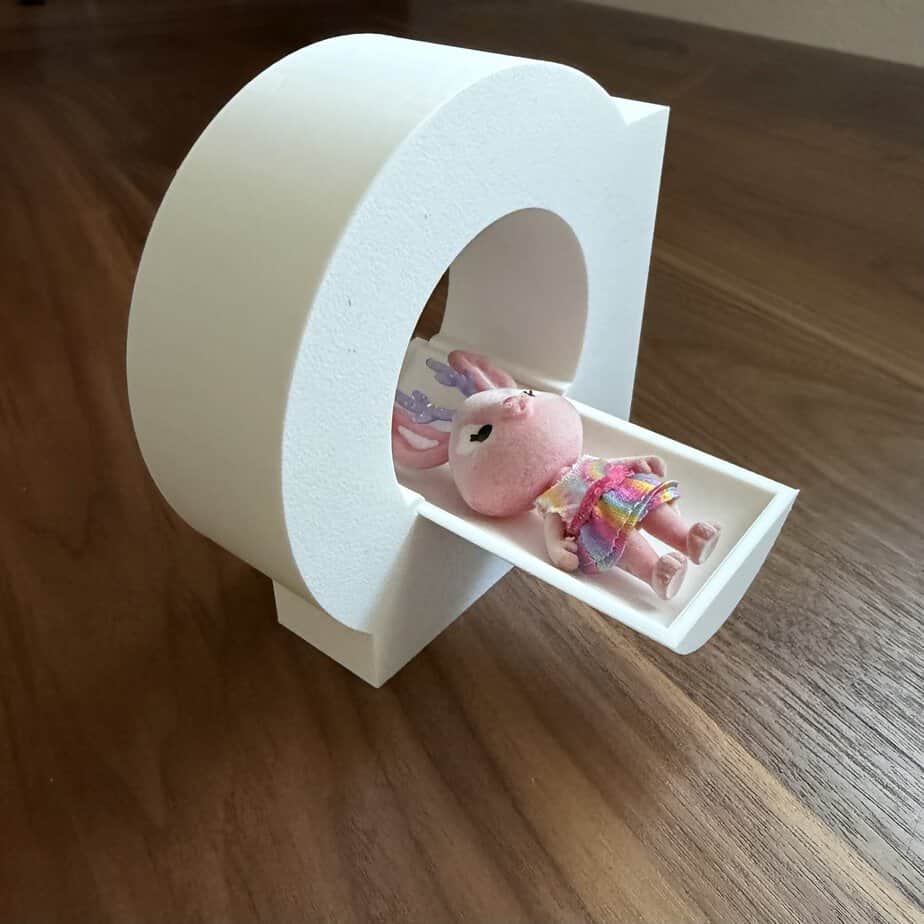
My wife overheard her playing with it, as one critter was telling another it was time for her scan.
“It’s your turn to take a nap in the MRI machine,” one says.
“What’s an MRI machine?” asks the patient.
“Oh, it’s just a machine that gives you extra critter magic.”
Amazon founder Jeff Bezos on his decision to start an online bookstore in the 1990s:
The framework I found which made the decision incredibly easy was what I called the regret minimization framework. I wanted to project myself forward to age 80 and look back on my life and I want to have minimized the number of regrets I have. And I knew that when I was 80 I was not going to regret having tried this. I was not going to regret trying to participate in this thing called the internet that I thought was going to be a really big deal. But I knew the one thing I might regret is not ever having tried. And I knew that that would haunt me every day. So when I thought about it that way it was an incredibly easy decision.
With unavoidable uncertainty and wild problems, sometimes regret minimization is the best paradigm we have.
Basecamp’s Jason Fried’s brief discussion of product development should be required reading for anyone who designs software, including EHRs, PACS, dictation, or whatever new dumb AI implementation someone is pitching to revolutionize healthcare (but that no one talked to an actual doctor about).
The critical tension is the balance between making features obvious, easy, and possible. You have to have opinions, and you have to choose, because being everything to everyone isn’t an option.
Our family had some nice, quiet snow days over the weekend here in Dallas, so I finally finished this historically interesting if morbid Lego mosaic of the first CT scan from 1971 (right frontal GBM):
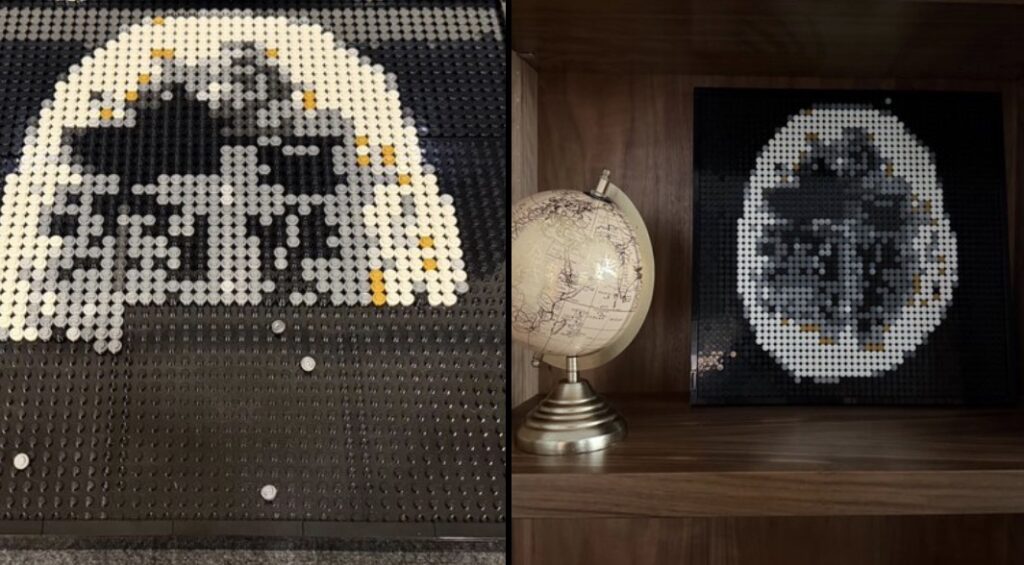
The Stoics thought everyone should have a memento mori, but the typical skull is so staid.
I’m in the new episode 7 of AJR’s Radiology Trailblazers podcast with Dr. Lindsey Negrete and Dr. Amy Maduram. Please do not think for a second that I accept my inclusion in any “trailblazing” premise(!), but we had a nice discussion about the writing process in and out of radiology. Whenever I do a podcast, I am always able to create at least one new verbal tic. This time it was “in reality”—please forgive me.
Author Tim O’Reilly, in his 2006 commencement speech at UC Berkeley:
Money is like gasoline during a road trip. You don’t want to run out of gas on your trip, but you’re not doing a tour of gas stations.
From Developmental Editing by Scott Norton:
Few pleasures are as great as the taste of a fresh idea. A new insight melts in the brain like chocolate on the tongue. Whether the insight is unprecedented in human history or news only to yourself doesn’t matter; the first time a thought occurs is always magic.
That magic is so fickle, perishable. I always find the strong desire to capture as much of it as possible, and the more I can horde upfront the better chance I have of making it to the finish line of anything.
Kevin Kelly, adding 101 new bits to his growing collection of pithy advice. A few of my favorites:
- Forget trying to decide what your life’s destiny is. That’s too grand. Instead, just figure out what you should do in the next 2 years.
- Try to define yourself by what you love and embrace, rather than what you hate and refuse.
- Read a lot of history so you can understand how weird the past was; that way you will be comfortable with how weird the future will be.
- There should be at least one thing in your life you enjoy despite being no good at it. This is your play time, which will keep you young. Never apologize for it.
- The patience you need for big things, is developed by your patience with the little things.
- There is a profound difference between thinking less of yourself (not useful), and thinking of yourself less (better).
Avoid making any kind of important decision when you are either hungry, angry, lonely, or tired (HALT)
From a highly enjoyable “So you wanna de-bog yourself” (about getting “unstuck”) by Adam Mastroianni:
“Declining the dragon” – a medieval knight metaphor for getting unstuck: Sometimes I’ll know exactly what I need to do in order to leave the bog, but I’m too afraid to do it. I’m afraid to tell the truth, or make someone mad, or take a risk. And so I dither, hoping that the future will not require me to be brave.
Everybody thinks this is a bad strategy because it merely prolongs my suffering, but that’s not why it’s a dumb thing to do. Yes, every moment I dither is a moment I suffer. But when I finally do the brave thing, that’s not the climax of my suffering—that moment is the opposite of suffering. Being brave feels good. I mean, have you ever stood up to a bully, or conquered stage fright, or finally stopped being embarrassed about what you love? It’s the most wonderful feeling in the world. Whenever you chicken out, you don’t just feel the pain of cowardice; you miss out on the pleasure of courage.
Medieval knights used to wander around hoping for honorable adventures to pop up so that they could demonstrate their bravery. They were desperate for big, scary dragons to appear. When I put off doing the brave thing, I am declining the dragon: missing an opportunity to do something that might be scary in the moment but would ultimately make me feel great.
The whole post makes for great early January reading.
About working as a hospital employee, from “The Young Physician Trap: Trading Autonomy for Salary” in Claim Denied:
And then comes the pay cut. It’s framed as “efficiency.” Or “underperformance.” The implication is clear: you’re the problem.
By now, the hospital knows they have you.
You bought a home. You structured your life around the salary they dangled. Maybe you counted on loan forgiveness. There might be a non-compete at play. Maybe your spouse’s career is tied to the area. Leaving suddenly isn’t easy.
In 2025, I shared something like 90 regular posts and 30 asides (clearly, I have not fully embraced the microblog component of the site I added during the 2023 redesign). The total wordcount of all that writing is a bit over 70,000 words (closer to 55,000 excluding blockquotes). So I wrote a book this year. Kinda. Well, it’s something at least.
I also have 65 articles drafted, some of which will definitely never generate photons on any of your devices, but many of which just need polishing and will appear here in 2026. As a reminder, all regular posts find their way to the archive list, and the asides are collected here. Happy New Year!
From The World I See, a memoir by the godmother of AI, Dr. Fei-Fei Li:
This, collectively, is the next North Star: reimagining AI from the ground up as a human-centered practice. I don’t see it as a change in the journey’s direction so much as a broadening of its scope. AI must become as committed to humanity as it’s always been to science. It should remain collaborative and deferential in the best academic tradition, but unafraid to confront the real world. Starlight, after all, is manifold. Its white glow, once unraveled, reveals every color that can be seen.
Medicine’s narrowest job board, Independent Radiology—the home of radiology private practice—is sitting pretty again at 150 groups. A few groups sadly closed for good, and some—fantastically—are fully hired up, but it looks like we’ll close the year back at that nice round number. If you’re looking for an opportunity, perusing the listings is good holiday homework.
Modern Illustration is a delightful online archive of vintage (c.1950-1975) illustration curated by Zara Picken.